Reviewed · FULL-DAY
3 full day private tours in Georgia
Georgia packs a lot into a small country. This three-day private tour makes the most of it, linking Tbilisi’s old lanes, mountain monasteries, the Georgian Military Road, and Kakheti’s wine country. I like the private car and guide, which remove the strain of arranging long day trips, and I like the strong mix of city sights, religious monuments, mountain views, and local wine. The main drawback is its pace: three full days cover a great deal, but you will spend plenty of time on the road.
You meet your guide-driver each morning at your chosen pickup address in Tbilisi. The schedule can be adjusted, and complimentary Wi-Fi helps during the long drives. At $150.49 per person, the value is strongest for a small group that wants private transport and a broad first look at Georgia rather than a slow, stay-in-one-place holiday.
In This Review
- The best parts of the three-day plan
- Day one: Tbilisi from grand avenues to old lanes
- Three hours on foot in Old Tbilisi
- Sameba Cathedral and Mount Mtatsminda
- Day two: the Georgian Military Road to Gudauri
- Jvari and Mtskheta, Georgia’s old spiritual center
- Zhinvali Reservoir and Ananuri Castle
- Gudauri Panorama and the Caucasus
- Day three: wine, faith, and Sighnaghi
- Kakhetian Traditional Winery in Patardzeuli
- Bodbe Monastery and the Alazani Valley
- Two hours in Sighnaghi, the City of Love
- What the private format is worth
- Who should book these three days
- FAQ
- Where does the three-day tour begin?
- Is this a private experience?
- How long is the Tbilisi city tour?
- What places are visited on the Gudauri day?
- Does the tour include wine tasting?
- Are admission fees included?
- What happens if bad weather cancels the tour?
- Should you book it?
The best parts of the three-day plan
- Georgia’s major contrasts in one package: Tbilisi, ancient Mtskheta, the Caucasus mountains, and Kakheti wine country all fit into three days.
- A private guide-driver each day: You avoid public transport connections and can discuss changes to the route.
- The Georgian Military Road: Jvari, Zhinvali Reservoir, Ananuri, and Gudauri create one of the most scenic day trips from Tbilisi.
- Sighnaghi and Kakheti wine: The final day shifts from mountain roads to vineyards, monasteries, and a hilltop town.
- Complimentary Wi-Fi: A small but useful benefit during long drives between stops.
- Some costs remain separate: Entry fees are not included, so keep money available for any paid admissions or tastings not covered by the day’s arrangements.
Day one: Tbilisi from grand avenues to old lanes
The first day is devoted to Tbilisi, and it wisely mixes a driving tour with a long walking section. That matters because the capital is spread across hills and districts. A car lets you see more ground, while walking through Old Tbilisi gives you the close-up details that a drive-by tour cannot provide.
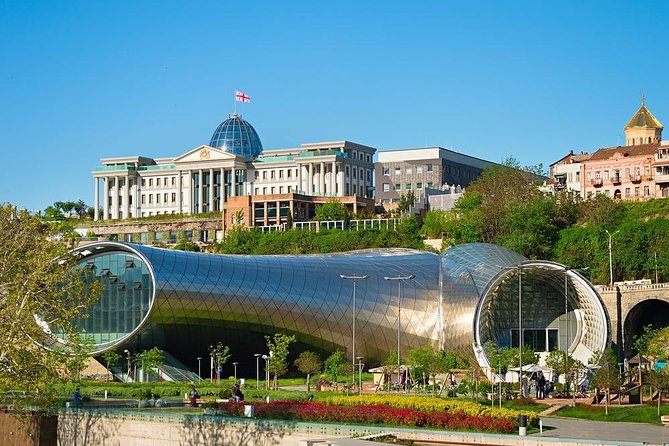
The opening drive passes Freedom Square, Rustaveli Avenue, Heroes Square, Agmashenebeli Avenue, and the President House. This is a useful introduction to the city’s main axes. You get a sense of Tbilisi as both a modern capital and an old crossroads, with grand public buildings beside older neighborhoods.
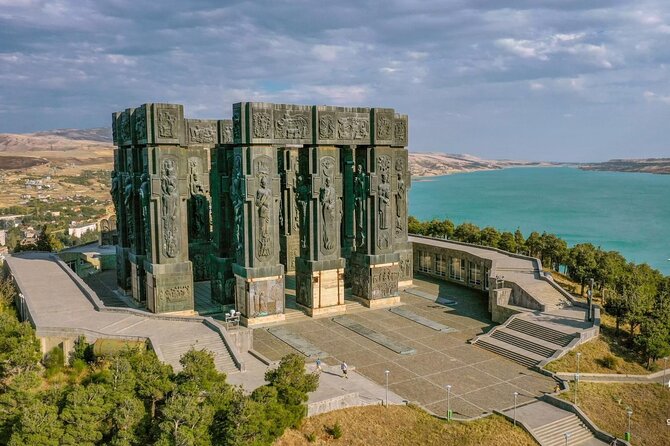
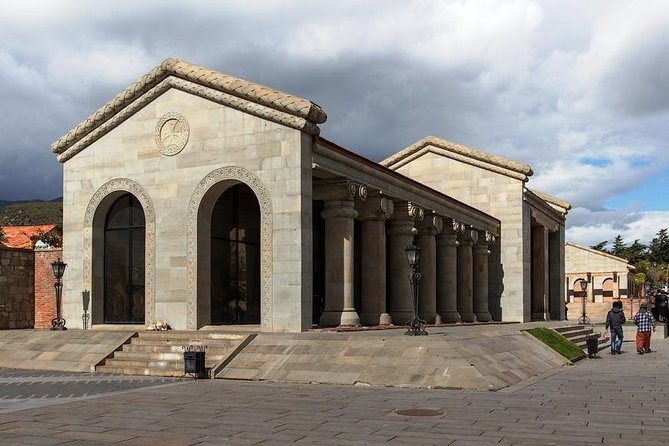
The first major stop is the Chronicles of Georgia, also called the Georgian History Memorial or Georgian Stonehenge. The huge stone columns were designed by Zurab Tsereteli and show scenes from roughly 3,000 years of Georgian history. The stop lasts about 30 minutes, which is enough to walk among the columns, take photographs, and hear the basic story behind the monument.
This is not a delicate ancient ruin. It is a bold modern work with oversized figures and a wide view over the city and water. Some people will find it dramatic; others may prefer the older sites later in the day. I like its place in the itinerary because it gives you a visual introduction to Georgia’s national story before you enter the old city.
More Tbilisi days to weigh up
- Tbilisi: Day Trip to Kazbegi, Gudauri, Gergeti, and Ananuri
★ 4.9 · 3,203 reviews - Day Trip to Kakheti Wine Region Including 9 Wine Tastings
★ 5.0 · 2,774 reviews - Highlights of Caucasus Mountains-Jinvali,Ananuri,Gudauri,Kazbegi(Group tour)
★ 5.0 · 2,682 reviews
Three hours on foot in Old Tbilisi
The walking portion lasts about three hours and includes many of the city’s most recognizable sights. You will see the sulphur pools, the Bridge of Love, Lekhvakhevi Waterfall, Meidan Bazaar Tunnel, the Gorgasali Monument, Tbilisi Fortress, Mother of Georgia, Rike Park, the Bridge of Peace, the Tamada Monument, Shardeni Street, and the Clock Tower of Revaz Gabriadze.
That is a generous list for one walking block. The benefit is coverage. You will encounter the parts of Tbilisi that first-time visitors usually want to understand, from the sulphur bath district to the riverfront and hilltop views. The drawback is that the stop names do not mean every place receives a long visit. With so much included, ask your guide which sights will be brief photo stops and which will get more explanation.
The sulphur pools help explain why Tbilisi developed here. The name is linked to the warm springs, and the old bath district remains one of the city’s defining areas. Lekhvakhevi Waterfall is a surprising urban sight, tucked close to the old neighborhoods rather than out in the countryside.
Rike Park and the Bridge of Peace offer a very different face of the capital. Their modern design contrasts with the old streets around Meidan and Shardeni. That contrast is part of Tbilisi’s appeal, although visitors who prefer quiet historic quarters may find the modern riverfront less atmospheric.
The Gorgasali Monument recalls Vakhtang Gorgasali, the king traditionally associated with Tbilisi’s founding. At the Tamada Monument, you get a nod to Georgia’s famous wine-hosting culture. The Gabriadze Clock Tower is another memorable stop, with its playful, slightly crooked appearance. I would keep your camera ready, but also leave room to simply look around. This part of the city rewards attention to small details.
Sameba Cathedral and Mount Mtatsminda
The Holy Trinity Cathedral, or Sameba, takes about 30 minutes. At 101 meters, it is the highest church in Georgia, and its gold-colored dome can be seen from many parts of Tbilisi. The complex includes the Patriarch’s residence, a monastery, a theology school and academy, a hotel, and nine chapels, including five below ground.
The cathedral is often described as a symbol of new Georgia. You do not need a long visit to appreciate its scale, but modest dress and respectful behavior are appropriate at this active religious site.
The final stop is Mount Mtatsminda, above Tbilisi. A large Ferris wheel sits at the mountain’s edge, with broad views over the capital. The listed stop is only about 20 minutes, so treat it as a viewpoint rather than a full amusement park visit. It is a good final pause after several hours of walking, especially as the city’s streets and river become easier to understand from above.
Day two: the Georgian Military Road to Gudauri
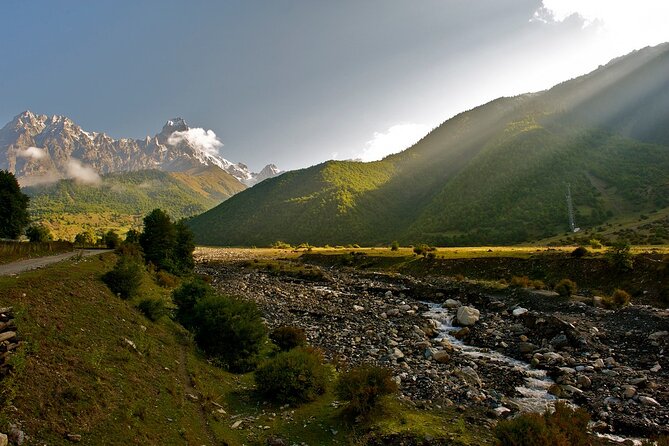
Day two is the most road-focused day. You head north from Tbilisi toward Gudauri, traveling about 120 kilometers along the Georgian Military Road. The route links churches, reservoirs, fortifications, and high mountain viewpoints.
The distance itself is not the whole story. Mountain roads can make a day feel longer than the mileage suggests, and several stops involve short walks over uneven ground. The private vehicle is especially useful here because the route is difficult to handle independently in a single day.
A slower pace, same corner of the Caucasus:
- From Tbilisi: Kakheti Wine Region Tour with 9 Wine Tastings
★ 4.9 · 2,541 reviews - Tbilisi: Mtskheta, Jvari, Gori and Uplistsikhe Day Tour
★ 4.9 · 2,396 reviews - From Tbilisi to Kazbegi, Ananuri, Gudauri & Gergeti
★ 4.9 · 2,278 reviews - Tbilisi: Kakheti Wine Region Tour with 10 Wine Tastings
★ 5.0 · 2,160 reviews
Jvari and Mtskheta, Georgia’s old spiritual center
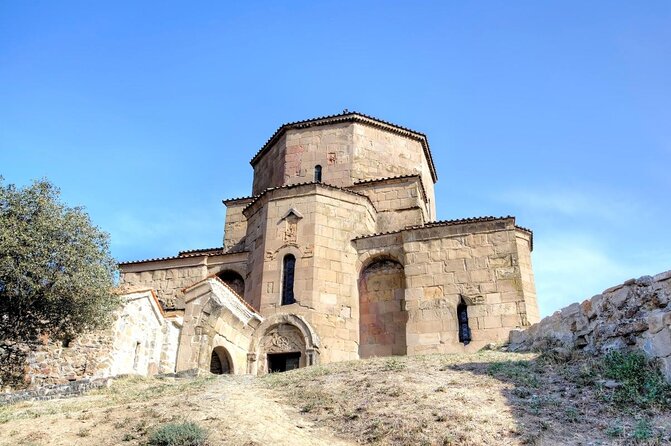
Jvari Monastery is the first stop. The sixth-century church sits high above the meeting point of the Aragvi and Kura rivers. From the hill, you get a memorable view of the surrounding countryside and the river junction below.
The name Jvari means cross in Georgian, and your guide can explain the story behind the church. The visit lasts about 30 minutes, which is enough for the view and a look inside, though anyone fascinated by early Georgian church architecture may want more time.
You then continue to Mtskheta, a UNESCO World Heritage Site inhabited for about 2,700 years. It served as Georgia’s capital until the fifth century. The town contains several important monuments, including the Pompey Bridge, Bebris Castle, and Svetitskhoveli Cathedral.
Svetitskhoveli is the key visit. It is Georgia’s main Orthodox cathedral, and tradition holds that Christ’s robe is buried there. You do not have to accept every sacred tradition as historical fact to understand the cathedral’s importance. This is one of the places where Georgia’s religious identity, royal past, and living worship meet.
The time in Mtskheta is listed at about 40 minutes. That is tight for a town with several monuments. I would ask your guide to prioritize Svetitskhoveli and the most important view or structure rather than trying to rush through every site.
Zhinvali Reservoir and Ananuri Castle
The next stop is Zhinvali Water Reservoir, an artificial lake on the Aragvi River. The visit lasts about 15 minutes and is mainly for the view and photographs. The water can appear strongly turquoise, framed by wooded hills and mountain slopes.
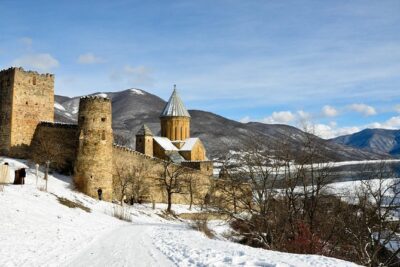
A short drive brings you to Ananuri Fortified Castle Ensemble. The complex includes two churches and a 16th-century defensive tower. It once served as the seat of the eristavis, or dukes, of Aragvi.
Ananuri is one of the most satisfying stops on this route because the setting does much of the work. You have a fortress, church architecture, mountains, and the reservoir all in one place. The 40-minute stop gives you time to walk around the walls and see the churches, though it is still not a leisurely archaeological visit.
The mix of stonework and water makes this an excellent photo stop, but watch your footing around old masonry and uneven surfaces. The tour information does not promise entry to every interior, so your guide will determine what is open and practical on the day.
Gudauri Panorama and the Caucasus
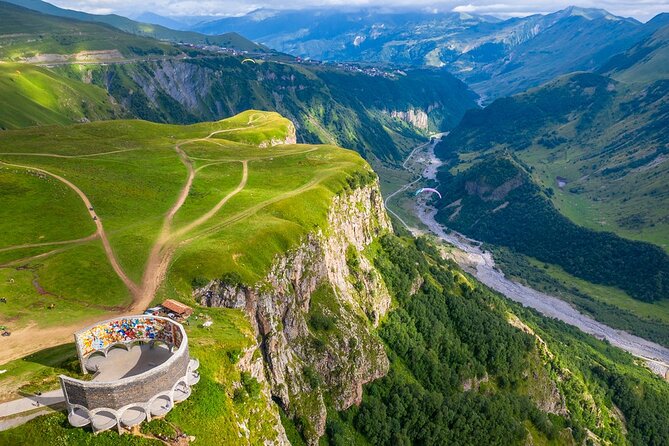
The final major stop is the Russian Georgian Friendship Monument near Gudauri. Gudauri is a ski resort at about 2,200 meters above sea level, and the ski season is given as December 25 through April 15. The lower lift station reaches 3,306 meters.
The monument was built in 1983 during the Soviet period to mark the bicentennial of the Treaty of Georgievsk and the stated friendship between Soviet Georgia and Soviet Russia. Its curved structure is decorated with colorful panels, and the viewpoint looks toward the Devil’s Valley and the Caucasus mountains.
The stop lasts about an hour, giving you more time than at several earlier viewpoints. Weather matters here. Clouds can hide the peaks, and winter conditions may change the feel of the visit. The good news is that the tour requires suitable weather and offers a new date or full refund if poor weather causes cancellation.
Day three: wine, faith, and Sighnaghi
The third day heads east into Kakheti, Georgia’s best-known wine region. This is a welcome change after the mountain road. You trade steep valleys for villages, vineyards, old churches, and views across the Alazani Valley.
The route is a good fit for anyone who wants more than monuments. Wine is part of Georgian culture, and the day gives you a chance to see production, taste local varieties, and learn about grape growing.
Kakhetian Traditional Winery in Patardzeuli
The first stop is the Kakhetian Traditional Winery in Patardzeuli. The factory visit lasts about 45 minutes and includes an explanation of wine making and tastings of different varieties.
The tour description does not specify how many wines are included or whether food accompanies the tasting, so ask before ordering anything extra. Also remember that some entry fees are at your own expense. The private format makes it easier to ask questions and set the pace, but the winery visit remains fairly short.
Georgia has a distinctive wine identity, and this stop gives context to the bottles you may encounter elsewhere in the country. I would treat it as an introduction rather than a full wine course. If wine is your main reason for visiting Kakheti, you may want to discuss customization before booking.
Bodbe Monastery and the Alazani Valley
Bodbe Monastery of St. Nino is the second stop. The Church of St. George contains the tomb of St. Nino, the woman credited with preaching Christianity in Georgia about 1,700 years ago and helping bring about the country’s Christianization.
The monastery grounds also provide a view toward the Alazani Valley and the Caucasus mountains. The stop lasts about 40 minutes, enough for the church, the grounds, and the outlook. As at Sameba and Jvari, remember that this is a functioning religious place. Quiet clothing and respectful conduct are the right choice.
Bodbe is valuable because it adds a personal story to the broader religious history. Instead of seeing only walls and domes, you learn about the figure connected to Georgia’s conversion to Christianity.
Two hours in Sighnaghi, the City of Love
Sighnaghi is the final stop. This attractive hill town is known as the City of Love, and you have about two hours to walk around, see its great wall, and try more local wine.
The extra time makes Sighnaghi feel less rushed than some of the earlier sites. You can wander through the town, take in the hill views, and let the day slow down. The walls are the main historical feature named in the itinerary, while the town itself supplies the atmosphere.
Do not expect a full rural Kakheti experience from this one day. The schedule samples the region through a winery, monastery, and hill town. That is enough to give you a clear sense of the area, but not enough to explore every village or vineyard.
What the private format is worth
The price is $150.49 per person, with group discounts available. That figure buys three private touring days with pickup offered, a dedicated vehicle, and a guide-driver rather than a seat on a large coach. For a small group, the cost can be a sensible trade for comfort and control.
The strongest value comes from the routes. Day two reaches places that are awkward to connect by public transport in one day, while day three covers several Kakheti stops without requiring you to arrange a driver yourself. Complimentary Wi-Fi is useful during the longer stretches between Tbilisi and the countryside.
The package is less compelling if you want long meals, extended museum visits, or time to linger at every church. It is designed for coverage. The rating of 4.7 out of 5, based on three recorded ratings, fits the experience’s main strength: a varied plan with a pleasant, flexible guide and good communication.
Who should book these three days
I would recommend this tour to a first-time visitor with only three days in Georgia. You will see the capital, the country’s religious center, a famous mountain route, and the main wine region without spending your limited time planning transport.
It also suits couples, families, and small groups who value a private vehicle. Most people can participate, and the tour is near public transportation, although the full schedule includes walking and visits to hilltop sites.
I would hesitate if your main goal is a slow cultural stay in Tbilisi. Day one alone is packed, and days two and three are long outings. You should also expect entry fees to be separate and recognize that weather can affect the mountain day.
Cancellation is flexible if you act early: cancel at least six full days before the start for a full refund. A cancellation two to six days ahead receives a 50 percent refund, while cancellations less than two days ahead are not refunded. All cut-off times use local time.
FAQ
Where does the three-day tour begin?
Each morning, the guide-driver meets you at your pickup address in Tbilisi.
Is this a private experience?
Yes. Only your group participates in the private tour.
How long is the Tbilisi city tour?
The first day lasts about eight hours, including the driving tour, Old Tbilisi walking tour, Sameba Cathedral, and Mount Mtatsminda.
What places are visited on the Gudauri day?
The route includes Jvari Church, Mtskheta, Zhinvali Water Reservoir, Ananuri Fortified Castle Ensemble, and the Russian Georgian Friendship Monument near Gudauri.
Does the tour include wine tasting?
The Kakhetian Traditional Winery visit includes tastings of different wine varieties and an explanation of wine making.
Are admission fees included?
Some entry fees are at your own expense. The listed stops themselves show admission as free, but you should confirm any additional charges with the provider.
What happens if bad weather cancels the tour?
If poor weather causes cancellation, you will be offered a different date or a full refund.
Should you book it?
Book this three-day private tour if you want a broad, efficient introduction to Georgia from a Tbilisi base. Its best moments come from the variety: old city streets in the morning, a fortress beside turquoise water the next day, and a glass of Kakhetian wine above the Alazani Valley on the third.
Skip it if you prefer unhurried days or plan to explore Georgia region by region. For everyone else, the private transport, flexible planning, and wide geographic reach make $150.49 per person a practical buy, especially for a small group with limited time.
Just added near Tbilisi
- Wine Tasting feel the Difference of Qvevri or Classical Wine★ 4.4 · 10 reviews
- Walking Tour in Old Tbilisi – Group Tour★ 4.5 · 8 reviews
- From Tbilisi: Kakheti and Kazbegi 2-Day 4X4 Jeep Tour pack★ 5.0 · 6 reviews
- Tbilisi: Vintage Fashion and Secondhand Thrifting Tour★ 5.0 · 11 reviews
- Uforgatable Kakheti Tour with wine tasting – in Georgia★ 4.9 · 5 reviews
- From Tbilisi: Uplistsikhe Caves and Mtskheta Town Day tour★ 5.0 · 2 reviews
- Private Adorable City Tour of Tbilisi★ 5.0 · 3 reviews
- Tbilisi Airport to Gudauri, Bakuriani, Batumi, Tbilisi★ 5.0 · 3 reviews
Full-Day, compared.

Kutaisi Canyons and Caves from Tbilisi Full Day Tour
Read our review →
Kazbegi and Gudauri Full Day Private Tour from Tbilisi
Read our review →
Full Day Private Wine Tour in Kakheti Region with Lunch and 3 Wine Tastings
Read our review →
Kazbegi Full-Day Private Tour with Scenic Stops from Tbilisi
Read our review →
Gudauri and Ananuri full day tour including hotel pick up
Read our review →