
Reviewed · WALKING TOURS
Alternative walking tour New Tiflis and backstreets
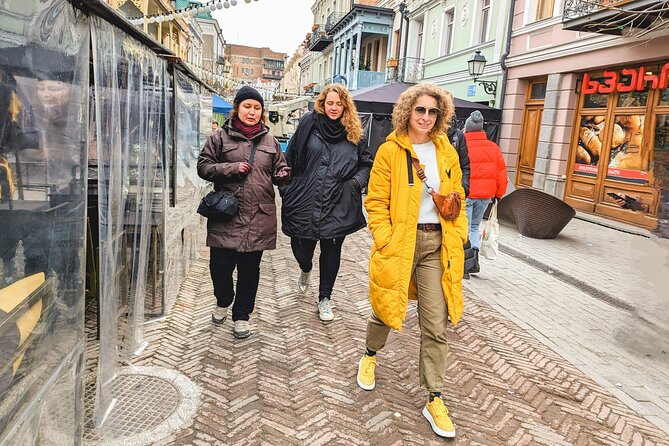
Tbilisi has more stories beyond its postcard center. This three-hour walk links Liberty Square with New Tiflis, passing flower stalls, Soviet memorabilia, rose gardens, street art, theatres, and quiet side streets that many first-time visitors miss. I like the route for two reasons: it shows everyday Tbilisi, and it gives you a clear look at how old buildings and former industrial spaces are being reused.
I also like the small maximum group of 10 and the chance to taste complementary wine along the way. Guide Oksana receives especially warm praise for her friendly manner and broad grasp of local art, daily life, and history. The main drawback is simple: you walk about 3 kilometers, sometimes beside busy roads, so this is not the right choice if you want a gentle, mostly seated introduction to the city.
The tour costs $30 per person and ends near Marjanishvili Metro Station. That makes it a useful half-day outing, especially if you want to continue exploring New Tiflis on your own afterward.
In This Review
- Key points at a glance
- Why this route gives you a better feel for New Tiflis
- Starting at Liberty Square
- Orbeliani Square, flowers, and official Tbilisi
- Dry Bridge Market and its Soviet-era curiosities
- Agmashenebeli Avenue and 19th-century facades
- Roses Park and the quieter backstreets
- Fabrika, from sewing factory to creative meeting place
- St. Peter and St. Paul Church in yellow Baroque
- Kote Marjanishvili Theatre and the final square
- What $30 buys you
- Walking conditions and who should book
- The guide makes the difference
- Should you book the New Tiflis walk?
- FAQ
- Is this an Old Town walking tour?
- How long does the tour take?
- How far do you walk?
- Where does the tour begin?
- Where does the tour end?
- Is wine included?
- How many people can join the tour?
- Is hotel pickup included?
Key points at a glance
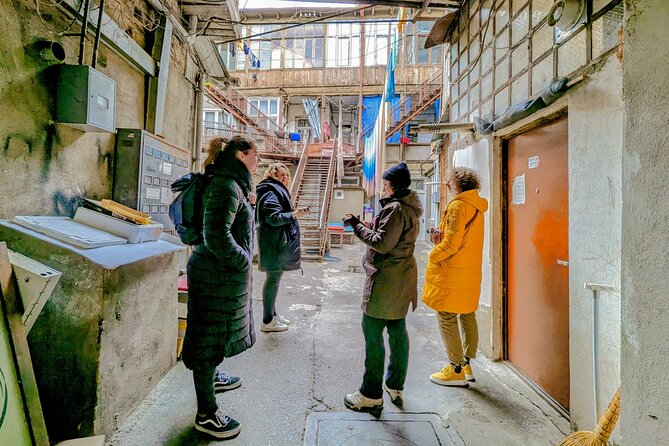
- A 3-kilometer route beyond the Old Town: The walk focuses on New Tiflis and less-touristed streets rather than the usual old-center sights.
- Dry Bridge Market in 30 minutes: Browse Soviet-era objects, antiques, handmade goods, vintage clothing, jewelry, and curious pieces with stories attached.
- A strong mix of architecture and daily life: Orbeliani Square, Agmashenebeli Avenue, St. Peter and St. Paul Church, and Marjanishvili offer very different views of the city.
- Fabrika adds a modern creative note: A former Soviet sewing factory now houses cafes, art, and street murals.
- Small groups help the guiding: With no more than 10 people, it is easier to hear explanations and ask questions.
- Plan for the weather and the pavement: Wear non-slip shoes, bring water in summer, and dress warmly in Tbilisi’s cold, wet winter conditions.
Why this route gives you a better feel for New Tiflis
Many first walks in Tbilisi stay around the Old Town, the sulfur baths, Narikala Fortress, and the river. Those sights deserve their place, but this tour takes a different tack. It moves north and west from Liberty Square into areas shaped by 19th-century development, Soviet urban life, creative renewal, and ordinary neighborhood routines.
That mix is the best reason to book it. You are not simply checking off monuments. You are watching the city change from grand civic square to flower market, flea market, formal avenue, residential backstreet, art courtyard, church, and theatre district.
The three-hour length is practical. It is long enough to cover a lot of ground but short enough to fit around lunch, a museum visit, or an evening performance. Since the route ends at Marjanishvili, you can continue with food, coffee, shops, or the metro without retracing your steps.
The group limit of 10 matters here. A backstreet walk works better when you can stop without blocking a large crowd, hear the guide clearly, and ask about details that catch your eye. Oksana is the guide most often singled out by name, with praise for her ability to discuss Tbilisi’s past, art, and daily life while keeping the walk pleasant.
More Walking Tours in Tbilisi
- Tbilisi Walking Tour Including Cable Car and Traditional Bakery
★ 5.0 · 1,310 reviews - Tbilisi: City Highlights Guided Walking Tour
★ 4.9 · 1,114 reviews - Tbilisi:Evening Walking & Talking Tour with Wine & Boat Ride
★ 5.0 · 572 reviews
Starting at Liberty Square
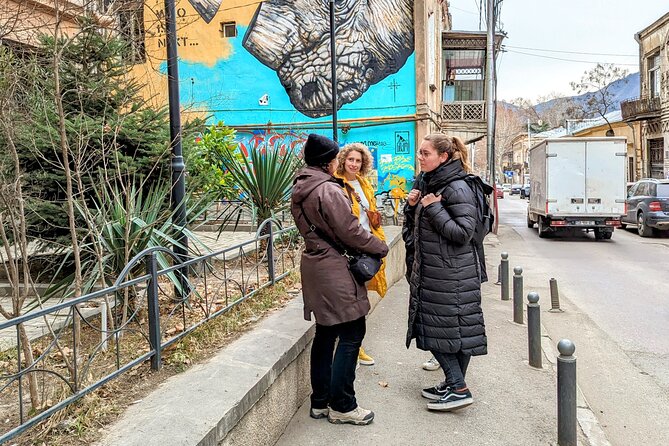
The meeting point is outside the Burberry shop at Freedom Square, also called Tavisuplebis Moedani. Confirm the exact corner before setting out, and arrive early. The guide waits only up to 10 minutes after the scheduled start, which is a firm rule worth taking seriously in a city where traffic can slow a short taxi ride.
The square is one of Tbilisi’s main public spaces. A statue of St. George defeating the dragon rises at its center, representing Georgia’s struggle for independence. The Georgian National Museum and City Hall are nearby, and the square has long been used for public gatherings, celebrations, and demonstrations.
You spend only about 10 minutes here, so think of it as orientation rather than a full sightseeing stop. It is also easy to reach by metro, which makes the meeting point convenient if you are staying elsewhere in the city.
Orbeliani Square, flowers, and official Tbilisi
The walk continues to Orbeliani Square, where ornate civic architecture meets a more relaxed cafe scene. The square is associated with Orbeliani Palace, the official residence of Georgia’s president. You view the exterior only, but the building gives the stop a formal, political character.
The flower market is the more sensory part of this visit. Stalls offer colorful blooms and fragrant herbs, adding a touch of local routine to the grand setting. You have about 25 minutes here, enough time for photographs and a closer look without turning the tour into a shopping stop.
This is one of the route’s useful contrasts. You see a place tied to government and public life, then notice the small details of a neighborhood market. If you like architecture, ask about the palace and surrounding buildings. If you prefer street scenes, spend your time around the flowers and cafes.
Dry Bridge Market and its Soviet-era curiosities
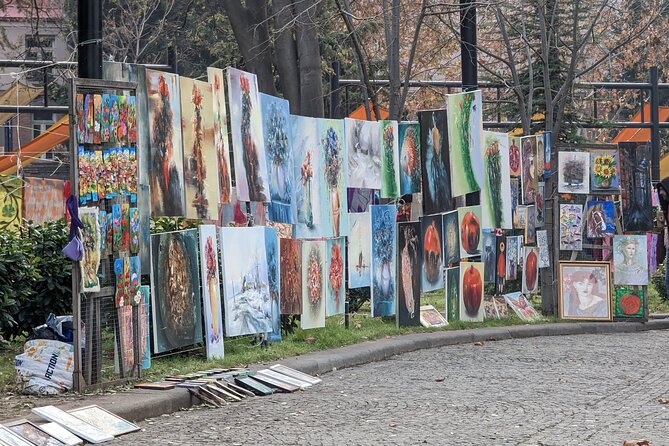
Dry Bridge Market is probably the most hands-on stop. You get around 30 minutes to browse stalls filled with antique furniture, old clothing, jewelry, Soviet-era memorabilia, and handmade objects.
The market can be uneven, which is part of its appeal. One table may hold an old household item, another vintage decoration, and another a piece made by a local artist. You might find a small souvenir with more character than a standard shop purchase, but you should take your time and examine goods carefully rather than expecting a polished retail experience.
The market also gives your guide plenty to explain. Objects from the Soviet period and earlier can open conversations about household life, trade, design, and memory in Georgia. Vendors may share what they know about their wares, though the tour does not promise a purchase or a particular kind of item.
Keep your wallet secure in any crowded market, and remember that 30 minutes is not enough for a slow, thorough hunt through every stall. I would treat this stop as a quick cultural browse, with shopping as a bonus.
A slower pace, same corner of the Caucasus:
- Tbilisi: Day Trip to Kazbegi, Gudauri, Gergeti, and Ananuri
★ 4.9 · 3,203 reviews - Day Trip to Kakheti Wine Region Including 9 Wine Tastings
★ 5.0 · 2,774 reviews - Highlights of Caucasus Mountains-Jinvali,Ananuri,Gudauri,Kazbegi(Group tour)
★ 5.0 · 2,682 reviews - From Tbilisi: Kakheti Wine Region Tour with 9 Wine Tastings
★ 4.9 · 2,541 reviews
Agmashenebeli Avenue and 19th-century facades

Agmashenebeli Avenue brings a change of scale. Its late 19th-century and early 20th-century buildings feature Art Nouveau and Neo-Renaissance details, including decorative facades that reward a slow look upward.
You spend about 25 minutes walking along the avenue. The point is not simply to admire one landmark. It is to notice the repeated details across a row of buildings and understand how this part of Tbilisi developed as a formal urban district.
The Marjanishvili Theatre is one of the key cultural buildings connected with the avenue. The Tbilisi Opera and Ballet Theatre is also located at the avenue’s northern end. The route does not include performances or interior tours, so you should see these stops as exterior architecture and city context.
Busy streets are part of this section. Traffic noise may bother you if you prefer quiet walking, and you need to stay aware while crossing or moving along the avenue. Still, the urban setting is valuable because it shows Tbilisi as a living city, not a preserved museum.
Roses Park and the quieter backstreets
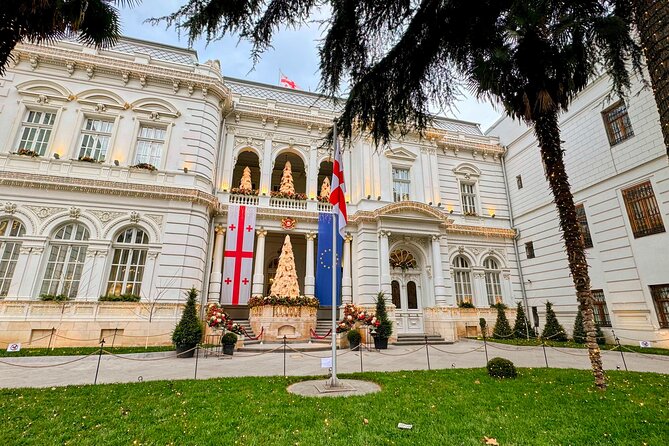
After the avenue, the route turns toward Roses Park. This smaller park provides a welcome pause from traffic and stone facades. Its rose garden contains more than 200 varieties, with the strongest display expected during the summer flowering season.
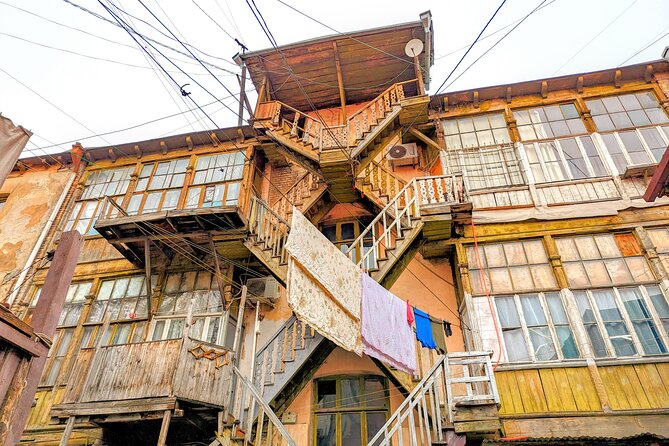
You spend roughly 20 minutes strolling through the garden. It is a simple stop, but it changes the rhythm of the walk. The park also offers a chance to see ordinary neighborhood life in the backstreets, away from Tbilisi’s main visitor routes.
The timing of your visit matters here. The tour description specifically highlights summer bloom, so the garden may be less impressive outside that period. Even then, the park remains a useful break and a look at a quieter side of the district.
Fabrika, from sewing factory to creative meeting place
Fabrika is the route’s clearest example of old space finding a new purpose. The building was once a Soviet sewing factory. It has since been turned into a multi-use center for art, culture, food, and social life.
You have about 25 minutes to see the space and its surroundings. The walls carry colorful street art by artists from Georgia and elsewhere, and the murals are a strong reason to keep your camera ready. The atmosphere here feels younger and more experimental than the formal streets earlier in the tour.
Fabrika also helps explain Tbilisi’s current identity. The city is not only about old churches and ornate buildings. It has a growing creative scene that uses former industrial sites in fresh ways. You can understand that change better here than through a standard monument visit.
The stop is still fairly short. If you want to sit for a drink, study every mural, or explore every corner, you may need to return independently. The tour gives you an introduction rather than a long stay.
St. Peter and St. Paul Church in yellow Baroque
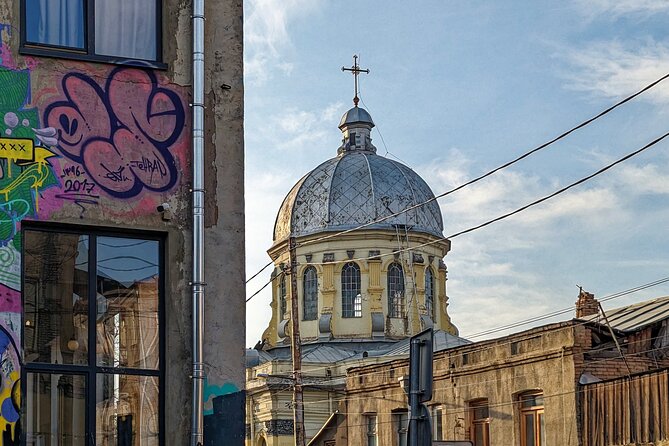
St. Peter and St. Paul Roman Catholic Church offers another sharp change in style. Built from 1870 to 1877, the church was designed by Albert Zaltsman after the project was initiated by K. Zubalashvili, an important member of Georgia’s Catholic community.
Its Baroque character is easy to spot. Pilasters and arches divide the yellow facade, while a rose window above the entrance features floral decoration and a dove. The facade was painted and altered after 2000, including changes to the original tall arched doorway.
The church also has a connection to Pope John Paul II, who celebrated Mass here during his 1999 visit to Georgia. You spend about 15 minutes at the stop. That is enough for the exterior and the main story, but not enough for a long religious or architectural study.
As with the other stops, do not assume admission inside is included. The tour lists the visit as free, but it does not promise an interior tour or a service. Dress and behave respectfully if the church is open for worship.
Kote Marjanishvili Theatre and the final square
The Kote Marjanishvili State Drama Theatre is one of Georgia’s important performance venues. Founded by Kote Marjanishvili in Kutaisi in 1928, it moved to Tbilisi in 1930 and has used the same building since then.
The theatre occupies an Art Nouveau structure that was renovated and reopened in 2006 with a production of Bertolt Brecht’s The Threepenny Opera. Today it presents plays, musicals, and operas. The tour gives you about 15 minutes here, so you see the building and learn its place in Georgian cultural life rather than attend a show.
The walk finishes at Marjanishvili Square, another 15-minute stop. Restaurants, cafes, and shops surround the square, making it a practical place to end the afternoon. Marjanishvili Metro Station is close by, and its name honors the theatre director Kote Marjanishvili. Look for his high-relief bust at the station.
This ending is well chosen. You finish in a district where you can keep exploring instead of being dropped at an isolated landmark.
What $30 buys you
At $30 per person, the tour offers solid value if you want a guided introduction to a section of Tbilisi you may not reach on your own. You get about three hours of guiding, a route covering nine stops, a small group capped at 10, and a complementary wine tasting.
The value depends on what you want from a walking tour. If your priority is entering major museums or historic interiors, this will feel limited because the listed stops are viewed from outside or explored as public spaces. If you want local context, architecture, street art, and practical orientation, the price is easier to justify.
Group discounts may reduce the cost for larger parties. Hotel pickup and drop-off are not included, but the start and finish are near public transport. That keeps the arrangement simple and gives you control over how you reach Liberty Square and where you go afterward.
Walking conditions and who should book
You should be able to walk about 3 kilometers at a relaxed pace. The route is not recommended if you have significant mobility issues, a recent injury, or difficulty walking long distances. Comfortable, non-slip shoes are essential because this is a real city walk, not a short stroll between drive-up sights.
Summer midday heat can be strong, so bring water and use sun protection. Winter weather may be cold, rainy, and windy. A warm waterproof layer will serve you better than a stylish but thin coat.
The tour suits first-time visitors who have already seen, or plan to see, Tbilisi’s Old Town and want another side of the city. It also suits repeat visitors, architecture fans, people interested in Soviet and post-Soviet spaces, and anyone who likes mixing landmarks with ordinary streets.
It is less suitable for someone seeking a relaxed cafe tour, a fully indoor activity, or a deep visit to each theatre and church. You should also expect traffic noise in parts of the route.
The guide makes the difference
A good guide matters more on a neighborhood walk than on a simple monument tour. Oksana is praised for being warm, clear, and able to answer questions about Tbilisi, Georgia, art, history, and daily life.
That range fits this itinerary. The tour moves from a national symbol to a flower market, a Soviet flea market, an Art Nouveau avenue, a rose garden, a former factory, a Catholic church, and a theatre. Without explanation, those stops could feel disconnected. With a strong guide, they become a picture of how Tbilisi has changed over time.
The experience has an overall rating of 4.9 from eight published ratings, with repeated praise for the guiding and for showing a side of Tbilisi that is easy to miss. One lower rating still described it as a good offbeat tour and specifically warned that the route involves plenty of walking. That is useful advice, not a serious criticism: wear the right shoes and know what you are signing up for.
Should you book the New Tiflis walk?
Book it if you want a small-group city walk with variety, especially after seeing Tbilisi’s Old Town. The combination of Dry Bridge Market, Fabrika, rose gardens, theatres, and backstreets gives you a broader sense of the city than a monument-only route.
Skip it if you need step-free sightseeing, dislike traffic noise, or want long interior visits. At $30, it is a fair buy for context, orientation, and a friendly guide, but its value comes from the route and stories rather than admission to major attractions.
Arrive early at Liberty Square, wear good shoes, carry water, and leave room afterward for a meal or coffee around Marjanishvili. That simple planning will let you enjoy the walk without rushing.
FAQ
Is this an Old Town walking tour?
No. The route focuses on New Tiflis, backstreets, markets, cultural buildings, and less-touristed neighborhoods rather than Tbilisi’s Old Town.
How long does the tour take?
The tour lasts approximately three hours.
How far do you walk?
You should be prepared to walk about 3 kilometers at a relaxed pace.
Where does the tour begin?
It begins at the entrance of the Burberry shop at Freedom Square, also known as Svobody Square or Tavisuplebis Moedani.
Where does the tour end?
It ends at Marjanishvili Square near Marjanishvili Metro Station.
Is wine included?
Yes. Complementary wine tasting is included in the tour.
How many people can join the tour?
The maximum group size is 10 travelers.
Is hotel pickup included?
No. Hotel pickup and drop-off are not included, so you need to make your own way to Freedom Square and from Marjanishvili after the walk.
Just added near Tbilisi
- Wine Tasting feel the Difference of Qvevri or Classical Wine★ 4.4 · 10 reviews
- Walking Tour in Old Tbilisi – Group Tour★ 4.5 · 8 reviews
- From Tbilisi: Kakheti and Kazbegi 2-Day 4X4 Jeep Tour pack★ 5.0 · 6 reviews
- Tbilisi: Vintage Fashion and Secondhand Thrifting Tour★ 5.0 · 11 reviews
- Uforgatable Kakheti Tour with wine tasting – in Georgia★ 4.9 · 5 reviews
- From Tbilisi: Uplistsikhe Caves and Mtskheta Town Day tour★ 5.0 · 2 reviews
- Tbilisi Airport to Gudauri, Bakuriani, Batumi, Tbilisi★ 5.0 · 3 reviews
- Private Adorable City Tour of Tbilisi★ 5.0 · 3 reviews
Walking Tours, compared.

Tbilisi Walking Tour Including Cable Car and Traditional Bakery
Read our review →
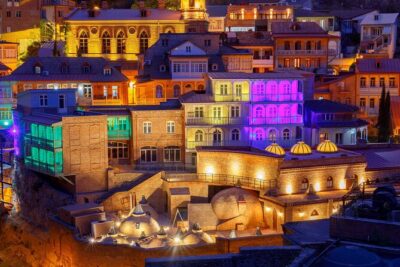
Evening Walking & Talking Tour with Wine & Boat Ride
Read our review →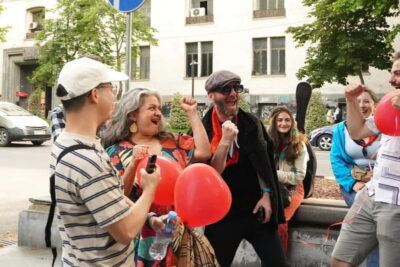
Evening Walking Tour with Wine & Boat Ride Options
Read our review →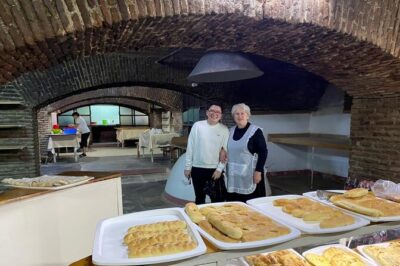
Old Tbilisi Highlights walking tour with wine & 10 tastings
Read our review →
Old Tbilisi Tour: Private Walking Tour With Wine Tasting
Read our review →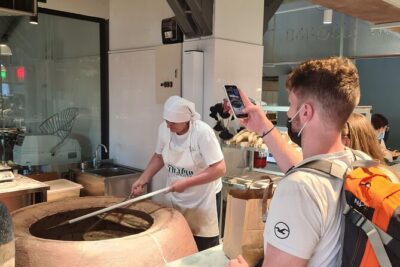
Private Tbilisi Food Tour: 9 Tastings Walk in Bohemian District
Read our review →
Tbilisi Old Town Walking Tour with a Local Guide
Read our review →Browse the lists this tour appears in