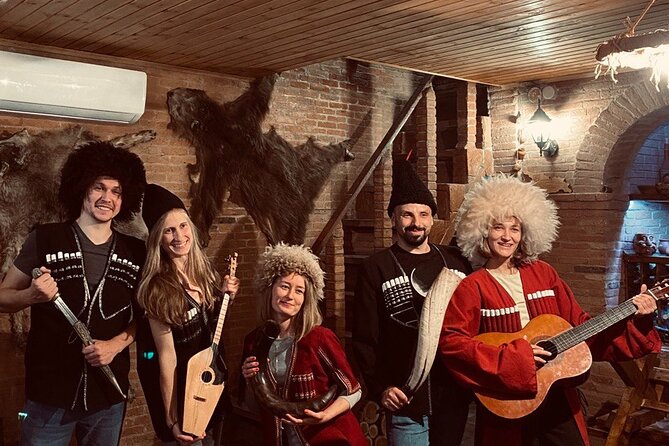
Reviewed · HALF-DAY
Half-Day Famous Georgian Supra Feast
A feast with a lesson attached. This four-hour evening pairs Old Tbilisi sightseeing with a home-style supra, cooking instruction, wine, song, and dance. I like the small-group format, with a maximum of eight people, and I like that the meal takes place with a family of hereditary winemakers rather than in a standard restaurant.
The food is a major draw, especially the hands-on khinkali and khachapuri class. The main caution is language: English is offered, but one past account describes much of the event taking place in Russian, with only limited English translation. Confirm the language arrangements before paying $150.
In This Review
- Key points at a glance
- From Meidan Bazaar to the city’s famous churches
- A family home with views worth saving room for
- Making khinkali and khachapuri before eating them
- What arrives on the supra table
- Learning how a Georgian supra works
- Georgian dance and UNESCO-recognized singing
- Is $150 a fair price for four hours?
- Who will enjoy this evening most?
- My verdict on this Georgian supra
- FAQ
- Where does the experience begin?
- What time does the tour start?
- How long does the experience last?
- Where does the experience end?
- What sights are included in the walking portion?
- Is transportation included?
- What cooking lessons are included?
- What food is served at dinner?
- Are drinks included?
- Is the experience offered in English?
- How many people can join?
- Can I cancel for a full refund?
Key points at a glance
- Old Tbilisi before dinner: Walk from Meidan Bazaar through several of the capital’s best-known sights before the meal begins.
- Cooking with the family: Learn to shape khinkali and prepare Georgian bread before sitting down to eat.
- A full supra, not just a tasting: Expect salads, pickles, eggplant, khachapuri, khinkali, mtsvadi, cheese, churchkhela, wine, and chacha.
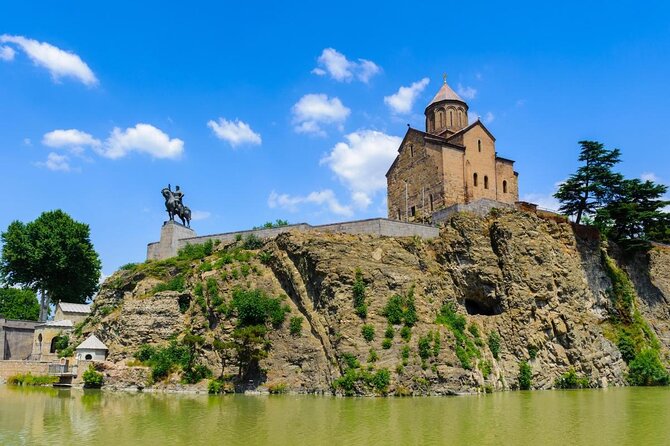
- Georgian feast customs: The tamada, or toastmaster, explains the order of toasts and the traditional use of a drinking horn.
- Music and movement: The evening includes Georgian dancing and live polyphonic singing, a cultural form recognized by UNESCO.
- Small group, private ride: Private transportation is included, and the group is listed as no larger than eight people.
From Meidan Bazaar to the city’s famous churches
The evening begins at 5:30 pm beside the I Love Tbilisi sign, at MRQ5+WG9 in Tbilisi. From there, the walk through Old Tbilisi gives you a useful first look at the city before the food takes over.
Meidan Bazaar is a fitting starting point. This part of town is tied to Tbilisi’s old trading culture, and the guide uses the walk to explain local legends, customs, and the story of the Georgian people. I would treat this section as an introduction rather than a full city tour. You are getting context and orientation, not a detailed museum visit.
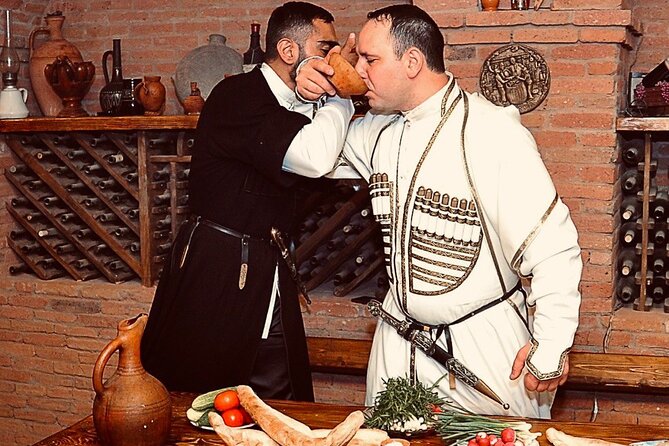
The route continues to Metekhi Cathedral. Its position above the river gives it particular visual appeal, and it helps you see how Tbilisi grew around steep hills, old churches, and the Mtkvari River. The stop should be especially useful if this is your first evening in the capital, since you can begin matching names to places you may revisit later.
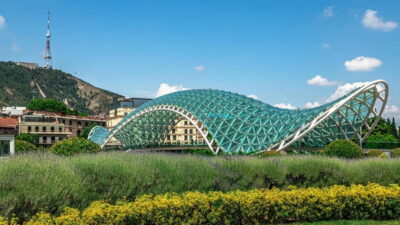
You also stop at Rike Park. The park sits in a modern part of the city and provides a change from the older lanes and church buildings. That contrast is one of the better features of the opening walk. Tbilisi is not a city that fits neatly into one period, and this short route lets you see old and new areas in quick succession.
The final listed stop is Tbilisi Holy Trinity Cathedral, also called Sameba. It is one of the city’s major religious landmarks and gives the tour a grand closing point before dinner. Exact time at each stop is not stated, so you should not expect a lengthy guided visit inside every site. The value here is the combined route and the stories that connect the sights.
More Tbilisi days to weigh up
- Tbilisi: Day Trip to Kazbegi, Gudauri, Gergeti, and Ananuri
★ 4.9 · 3,203 reviews - Day Trip to Kakheti Wine Region Including 9 Wine Tastings
★ 5.0 · 2,774 reviews - Highlights of Caucasus Mountains-Jinvali,Ananuri,Gudauri,Kazbegi(Group tour)
★ 5.0 · 2,682 reviews
A family home with views worth saving room for
After the city walk, private transportation takes you to the home of a Georgian family known for winemaking and cooking. The setting is part of the appeal. While the hosts prepare for the cooking class, you can look around the property and take photographs.
The views are described as particularly striking, but no exact viewpoint or neighborhood is provided. That means you should enjoy the setting without planning your evening around a specific panorama. Bring a phone or camera with enough battery, since this pause gives you a chance to take pictures before the table is filled.
I like this part because it slows the evening down. The tour is not simply a chain of stops followed by a restaurant booking. You move from the capital’s public sights into a family setting, where the meal has a stronger sense of occasion.
Still, the home setting may not suit someone who wants a polished restaurant meal with a fixed, formal schedule. The atmosphere is built around hospitality, conversation, food, and shared participation. If you prefer to eat quickly and move on, this is not the best use of four hours.
Making khinkali and khachapuri before eating them
The cooking class covers two Georgian staples: khinkali and khachapuri. That is a smart pairing because the dishes show two very different sides of Georgian cooking.
Khinkali are the familiar Georgian dumplings, traditionally filled with meat, though the menu also includes mushroom and cheese versions. The class gives you a chance to handle the dough and filling yourself. The practical lesson is not just about the recipe. You also start to understand why khinkali are eaten with care, since their hot juices are part of the pleasure.
Khachapuri is Georgian cheese bread, and the version listed here is Adjarian khachapuri, made with dough, cheese, and egg and served hot. It is usually recognized by its boat-like shape, though the tour information does not specify the exact shaping method taught. You should expect a practical demonstration rather than a professional cooking course.
The strongest benefit is timing. You make the food, then eat it as part of the larger feast. That makes the dishes easier to remember than food simply placed in front of you. One account describes the lesson as fun and specifically praises both the khinkali and Georgian bread instruction.
Do not expect every dish on the menu to come from the class. The cooking portion focuses on khinkali and khachapuri, while other dishes arrive as part of the meal.
What arrives on the supra table
The meal is generous by design. A Georgian supra is not a small plate tasting with one main course. Food arrives in several stages, and the table is meant to support long toasts and conversation.
The listed menu includes:
- Georgian salad with cucumbers, tomatoes, and herbs
- Pickled cucumbers, pickled tomatoes, sauerkraut, and Colchis klekachka
- Khinkali with meat, mushrooms, or cheese
- Eggplant
- Adjarian khachapuri
- Mtsvadi, Georgian meat cooked on skewers over coals
- Imeretian cheese
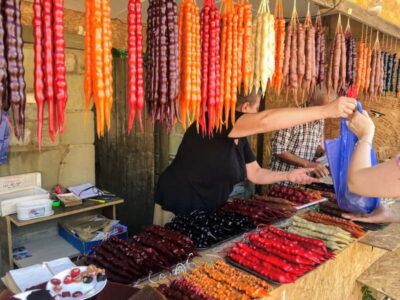
- Churchkhela, made with grape juice and walnuts
The salad and pickles provide a fresh, sharp start. They matter because the rest of the meal is rich and filling. Eggplant adds another vegetable dish, while the cheese bread and dumplings bring the heavier, more comforting food.
Mtsvadi is the meat course for anyone who wants something smoky and substantial. It is cooked on skewers over coals, which gives the meal a clear connection to outdoor Georgian cooking. Imeretian cheese and churchkhela round things out rather than acting like a separate Western-style dessert course.
The menu includes several dishes that may be unfamiliar to first-time visitors, especially Colchis klekachka and churchkhela. You will not need to know the names in advance. The point is to try a broad selection and learn how the food fits into a Georgian table.
The tour includes dinner, alcoholic drinks, coffee, and tea. One account describes the wine as unlimited, but the formal details only state that alcoholic beverages are included. I would ask the provider to clarify the drink policy if that matters to your budget or plans.
A slower pace, same corner of the Caucasus:
- From Tbilisi: Kakheti Wine Region Tour with 9 Wine Tastings
★ 4.9 · 2,541 reviews - Tbilisi: Mtskheta, Jvari, Gori and Uplistsikhe Day Tour
★ 4.9 · 2,396 reviews - From Tbilisi to Kazbegi, Ananuri, Gudauri & Gergeti
★ 4.9 · 2,278 reviews - Tbilisi: Kakheti Wine Region Tour with 10 Wine Tastings
★ 5.0 · 2,160 reviews
Learning how a Georgian supra works

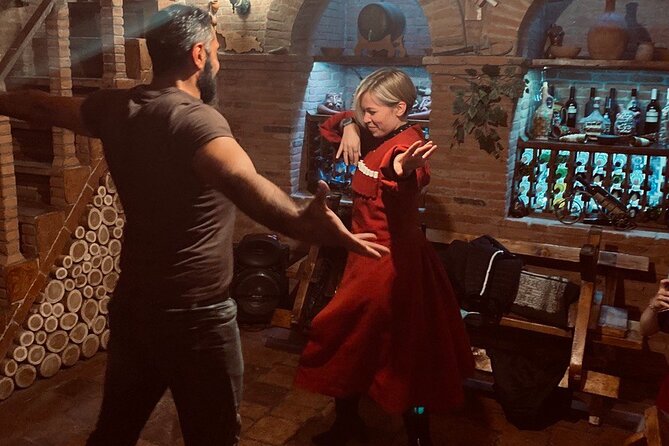
The food is only half of this evening. The tamada, or toastmaster, explains how the feast works, including the sequence of toasts and the proper way to drink from a horn.
This is valuable because a supra is not just a large meal. Toasts give structure to the evening, and the tamada guides the mood and order. You may hear toasts connected with family, friendship, Georgia, peace, or other themes, though the specific sequence is not provided.
The drinking horn is another detail that turns an ordinary dinner into a cultural lesson. You learn how it is used and why finishing the drink matters, since a horn cannot normally be placed upright on the table. You should pace yourself carefully. Wine and chacha are included, and the combination can catch up with you long before the final song.
The format also encourages conversation across the table. One account praised the host’s ability to make people feel welcome and connected, with an international mix of new friends by the end of the night. That social element is likely one of the main reasons to choose this experience instead of a standard evening meal.
The language point deserves attention. The activity is offered in English, and an English translator has been arranged successfully for at least one group. Yet another account describes an evening dominated by Russian, with little English translation. If you do not understand Russian, contact Georgian Promenade before booking and ask who will lead the event in English and how much translation will be provided.
Georgian dance and UNESCO-recognized singing

After the meal, the evening moves into performance and participation. Professional dancers teach you basic Georgian dance movements while folk music plays.
You should not expect a full stage show where you sit quietly from start to finish. The plan includes learning some basic movements, so comfortable clothing and shoes are sensible. The information does not specify a dress code, but anything that allows easy movement is a practical choice.
The program also includes Georgian polyphonic singing. This form of Georgian singing is recognized on UNESCO’s cultural heritage list, and hearing it in the middle of a family feast gives the music a setting that a short concert may not provide.
This ending works well because it brings together the main themes of the evening: food, hospitality, ritual, and performance. It is also one more reason not to treat the activity as a simple dinner reservation. You are paying for a guided cultural evening with several distinct parts.
Is $150 a fair price for four hours?

At $150 per person, this is not a budget meal. The price makes more sense when you count the full package: a guided walk through Old Tbilisi, private transportation, a cooking class, a large dinner, wine and other alcoholic drinks, coffee or tea, a tamada-led explanation of feast customs, dancing, and polyphonic singing.
The group size is listed as a maximum of eight people. That is important. A small group gives you a better chance to take part in the cooking class, ask questions, and follow the toasts without being lost in a crowd.
The value is strongest for a first visit to Tbilisi, especially if you want one organized evening that combines sightseeing and culture. It is less compelling if you already have a planned food tour, have limited interest in wine, or would rather choose each restaurant and sight yourself.
I would also factor in the private ride. Getting from the city walk to a family home outside the central route can be awkward without transport. Since the ride is included, you do not have to arrange a taxi between the different parts of the evening.
The activity is frequently booked around 18 days ahead. That is a useful planning clue, especially if you are visiting in a busy season or have fixed evening plans. I would reserve before arriving rather than count on a last-minute place.
Who will enjoy this evening most?

I would recommend it to you if you want direct contact with Georgian food and customs, not just a list of famous sights. It suits curious eaters, couples, solo visitors who enjoy meeting people, and small groups looking for a social night.
It is also a strong choice for anyone who wants to try several Georgian dishes in one sitting. The menu gives you a broad sample, while the class lets you make two of the best-known foods yourself.
Families may enjoy the activity, but the presence of wine and chacha is central to the evening. The information does not state a child price, age policy, or nonalcoholic alternative, so ask before booking if you are traveling with children.
You should think twice if you need a fully English-language program without any uncertainty. English is listed, but the past language problem makes confirmation worthwhile. You may also want to skip it if you dislike group participation, dancing, or long meals built around toasts.
The activity allows service animals and is near public transportation at the starting point. Confirmation is provided when you book. Cancellation is free if you cancel at least 24 hours before the 5:30 pm start, while cancellations or changes made later are not accepted for a refund.
My verdict on this Georgian supra
I would book this if I wanted one lively evening that introduced me to Tbilisi beyond its churches and old streets. The combination of family cooking, a serious spread of Georgian food, feast customs, music, and dance gives the night a clear purpose.
The best parts are the cooking class and the social meal. You do not just hear about khinkali, khachapuri, or the supra tradition. You handle the food, sit at the table, listen to the toasts, and take part in the evening’s customs.
The main condition is language. Ask Georgian Promenade to confirm that an English-speaking guide or translator will be present for your departure date. If that is settled, the $150 price is reasonable for a small-group cultural evening with food, drinks, transport, and entertainment included.
FAQ
Where does the experience begin?
It begins at the I Love Tbilisi sign at MRQ5+WG9 in Tbilisi.
What time does the tour start?
The start time is 5:30 pm.
How long does the experience last?
It lasts approximately four hours.
Where does the experience end?
It ends back at the meeting point.
What sights are included in the walking portion?
The route includes Meidan Bazaar, Metekhi Cathedral, Rike Park, and Tbilisi Holy Trinity Cathedral.
Is transportation included?
Yes. Private transportation is included.
What cooking lessons are included?
You learn to prepare Georgian khinkali and khachapuri.
What food is served at dinner?
The menu includes Georgian salad, pickles, eggplant, khinkali, Adjarian khachapuri, mtsvadi, Imeretian cheese, and churchkhela.
Are drinks included?
Yes. Alcoholic beverages, coffee, and tea are included.
Is the experience offered in English?
English is listed as an available language. Because one past account describes limited English translation during the event, confirm the arrangements with the provider before booking.
How many people can join?
The activity has a maximum group size of eight people.
Can I cancel for a full refund?
Yes, if you cancel at least 24 hours before the experience start time. Cancellations or changes made less than 24 hours before the start are not accepted for a refund.
Just added near Tbilisi
- Wine Tasting feel the Difference of Qvevri or Classical Wine★ 4.4 · 10 reviews
- Walking Tour in Old Tbilisi – Group Tour★ 4.5 · 8 reviews
- From Tbilisi: Kakheti and Kazbegi 2-Day 4X4 Jeep Tour pack★ 5.0 · 6 reviews
- Tbilisi: Vintage Fashion and Secondhand Thrifting Tour★ 5.0 · 11 reviews
- Uforgatable Kakheti Tour with wine tasting – in Georgia★ 4.9 · 5 reviews
- From Tbilisi: Uplistsikhe Caves and Mtskheta Town Day tour★ 5.0 · 2 reviews
- Tbilisi Airport to Gudauri, Bakuriani, Batumi, Tbilisi★ 5.0 · 3 reviews
- Private Adorable City Tour of Tbilisi★ 5.0 · 3 reviews
Half-Day, compared.

Half-Day Top Sights & Attraction Tour with Tastings
Read our review →