
Reviewed · MTSKHETA AND JVARI TOURS
Mtskheta: Day Tour to Oldest City in Georgia
Ancient churches, big views, and a short ride. This four-hour Mtskheta tour gives you a quick look at Georgia’s spiritual heart, with two clear strengths: Jvari Monastery’s hilltop setting and the chance to see Svetitskhoveli Cathedral, linked to Christ’s robe and Georgian kings. I also like that live commentary is offered in English or Russian. The main catch is time: you may spend nearly the whole outing at churches and monasteries, with little room for wandering through Mtskheta itself.
At $41 per person, the tour is a sensible way to cover several major sights without arranging transport yourself. Guide Stevan earned praise for keeping the group moving and answering questions, but the experience has some rough edges, including confusing meeting instructions at certain stops and one serious driving complaint involving phone use on the return trip.
In This Review
- Key points to know before booking
- Why Mtskheta matters in Georgian history
- Jvari Monastery and the view above two rivers
- Svetitskhoveli Cathedral and the robe tradition
- Samtavro Monastery and Georgia’s first Christian ruler
- The wine tasting adds a Georgian note
- What four hours really gets you
- Transport, guide quality, and comfort
- Is $41 a fair price?
- Who should book this Mtskheta tour?
- Should you book it?
- FAQ
- Where does the tour meet?
- How long does the Mtskheta tour last?
- How much does the tour cost?
- Which languages are available?
- What sights are included?
- Is food included?
- Do women need to bring a scarf?
- Can I cancel the tour?
- Do I have to pay when I book?
Key points to know before booking
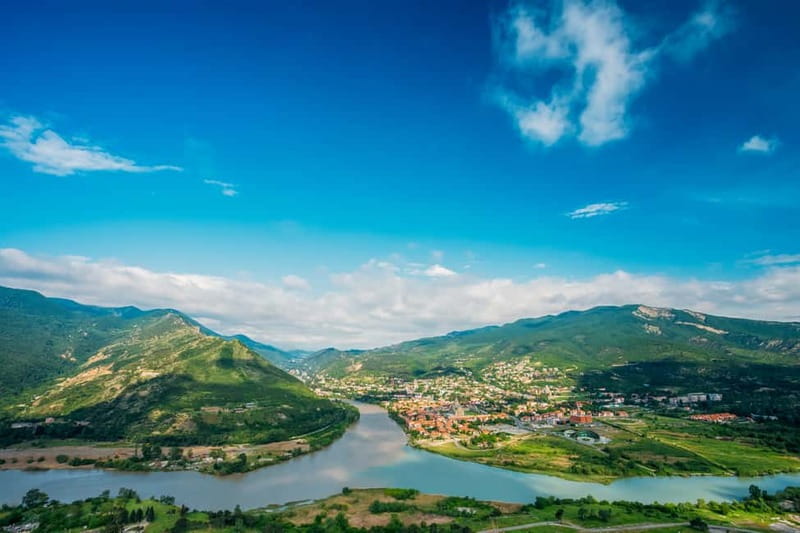
- Jvari Monastery gives you the best view: The sixth-century church sits above the meeting point of the Aragvi and Mtkvari rivers.
- Svetitskhoveli is the tour’s main historical stop: The cathedral is tied to the burial place of Christ’s robe and the tombs of Georgian kings.
- Mtskheta is more than a church stop: It was the capital of Iberia and the place where Georgia accepted Christianity in 317.
- Samtavro adds royal and monastic history: The complex contains the graves of Queen Nana, King Mirian III, and the monk Gabrieli.
- The schedule favors sightseeing over free time: You will see the headline monuments, but you may not have much time for shops, lunch, or an unhurried town walk.
- Bring a head covering: Women need a scarf to cover their heads when entering the monasteries.
Why Mtskheta matters in Georgian history
Mtskheta is one of Georgia’s oldest cities and served as the capital of the early Georgian Kingdom of Iberia from the third century BC to the fifth century AD. That alone gives the town weight, but its religious role is even more important.
Georgia accepted Christianity here in 317. Mtskheta remains the headquarters of the Georgian Orthodox and Apostolic Church, so this is not simply an archaeological stop or a pretty old town. It is a living religious center.
I like this tour because it connects the monuments to that larger story. You are not just moving from one stone church to another. You are seeing the places tied to the conversion of the kingdom, its rulers, its church, and one of the most important sacred traditions in Georgia.
The UNESCO World Heritage designation covers the historic monuments of Mtskheta, including Jvari Monastery and Svetitskhoveli Cathedral. The title matters, but the better reason to care is that these buildings show how Georgian architecture developed around worship, royal power, and pilgrimage.
More half-days at Mtskheta and Jvari:
- Tbilisi: Mtskheta, Jvari, Gori and Uplistsikhe Day Tour
★ 4.9 · 2,396 reviews - Day Trip to Mtskheta Gori and Uplistsikhe
★ 5.0 · 1,801 reviews - Tbilisi: Mtskheta Jvari Bazaar, Chronicles of Georgia & Wine
★ 5.0 · 1,088 reviews
Jvari Monastery and the view above two rivers
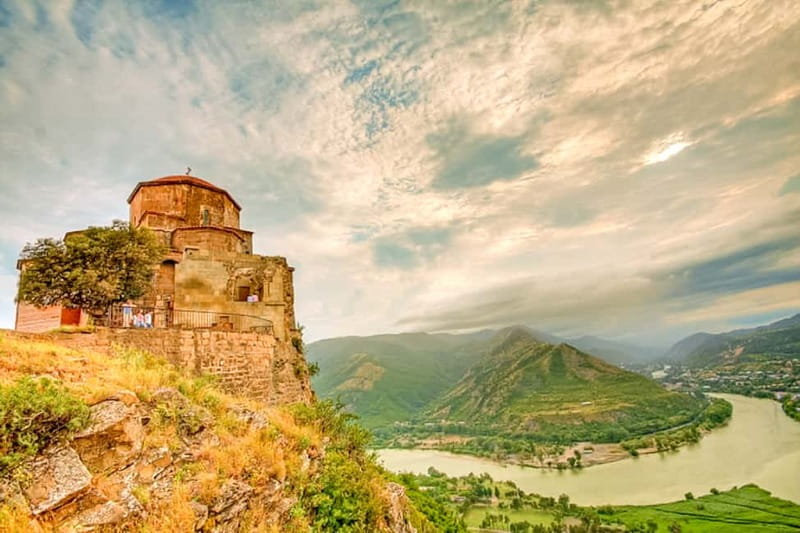
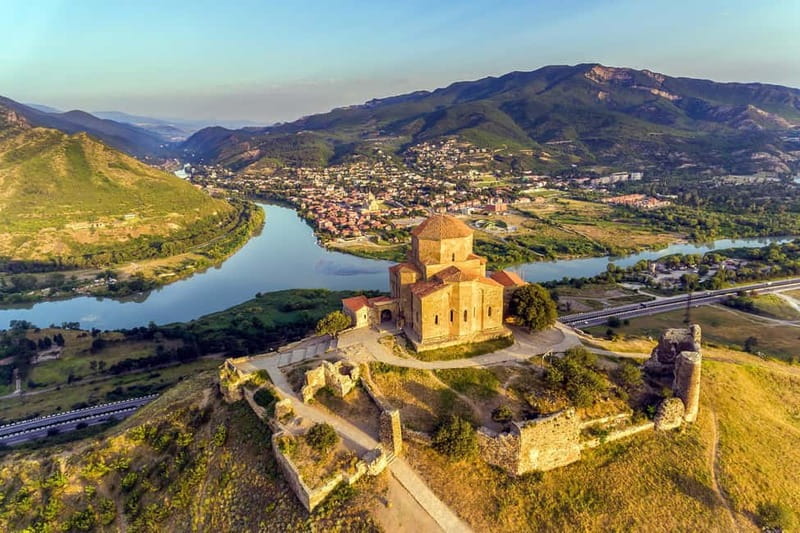
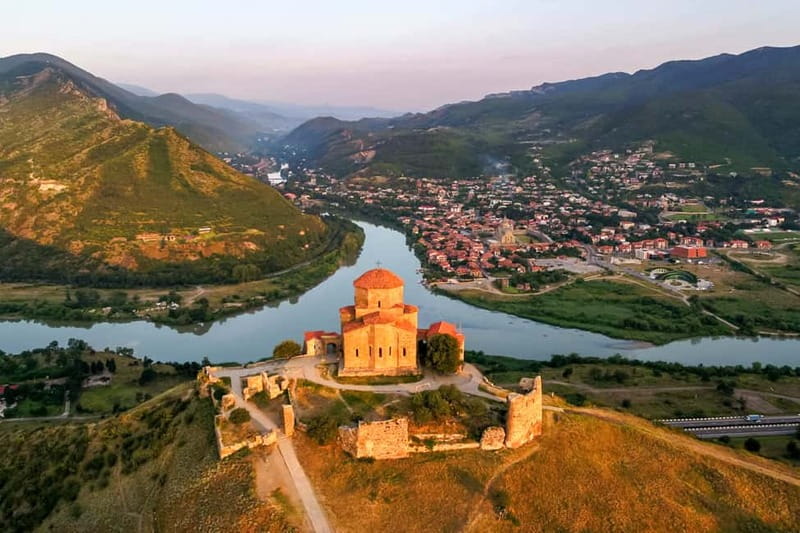
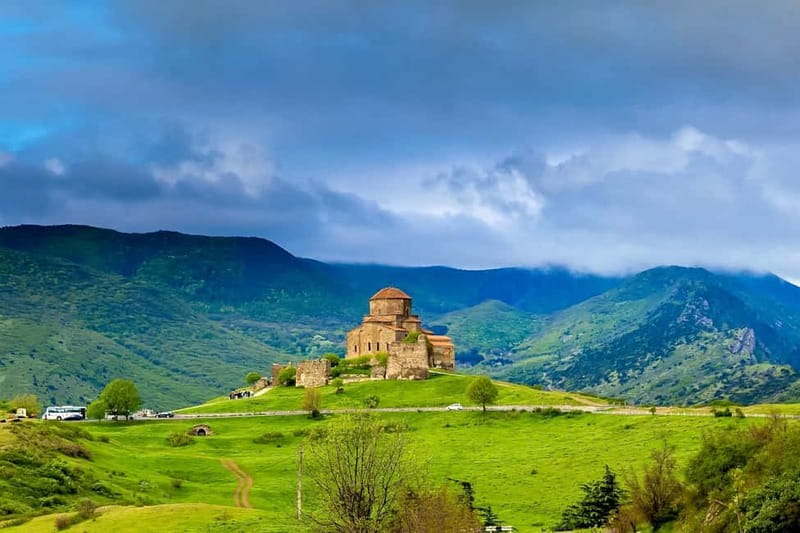
Jvari Monastery is usually the first major sight, and it is a strong opening. The sixth-century Georgian Orthodox monastery sits on a hill near Mtskheta, with views toward the confluence of the Aragvi and Mtkvari rivers.
The name Jvari translates as Monastery of Cross. The church is valued not only for its age but also for its design. The building represents a high point in Georgian church architecture, with a compact form that feels especially powerful when seen against the open hilltop.
For me, the setting is a large part of the appeal. From above, you can understand why Mtskheta became such an important settlement. The rivers meet below, the old city lies nearby, and the monastery feels tied to the terrain rather than dropped into it.
You should expect a short visit rather than a long period of quiet study. The guide explains the religious and architectural meaning, then the group moves on. That works well if you want the main facts and a fine viewpoint. It is less satisfying if you prefer to sit, sketch, photograph, or study every detail at your own pace.
Wear practical shoes if you have them. The supplied information does not describe the walking conditions in detail, so I would not plan on formal footwear for this stop. Also remember the head-covering rule for women entering the monastery.
Svetitskhoveli Cathedral and the robe tradition
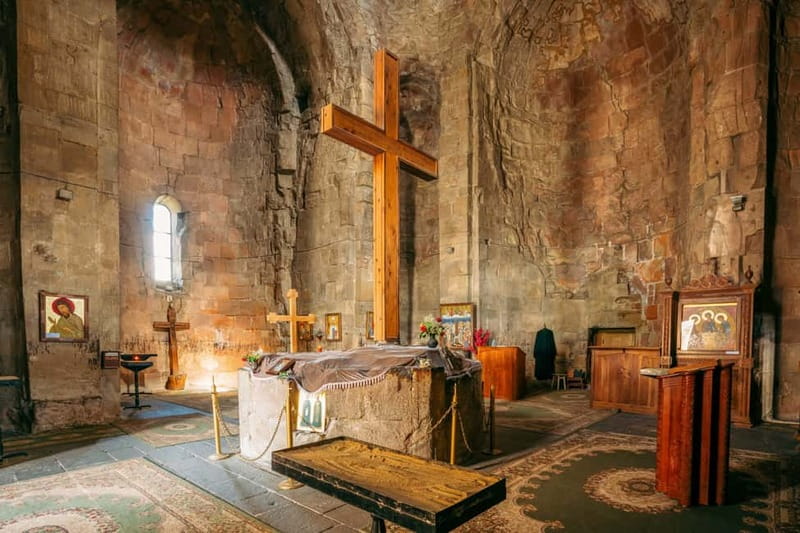
Svetitskhoveli Cathedral is the central stop in Mtskheta. The present building dates to the 11th century, but the religious site reaches back to the early fourth century, around the time Georgia adopted Christianity.
The cathedral is associated with the burial place of Christ’s robe, one of Georgia’s most important Christian traditions. It also contains the tombs of Georgian kings. These connections help explain why the church became a major pilgrimage point on the Silk Road.
The building itself has an elongated cross-shaped form that seems to reach upward. Its importance comes from a mix of artistic quality, scale, religious meaning, and history. It is the second largest church building in Georgia and part of Mtskheta’s UNESCO World Heritage listing.
I would pay close attention during the guide’s explanation here, especially if you are not familiar with Georgian Orthodox history. The cathedral can feel like a lot to absorb in a short time. One visitor found the religious information too heavy compared with the amount of free time in town. That is a fair warning, particularly for anyone who wants cafés, local stores, or a relaxed walk as much as church interiors.
Still, this is the stop that makes the half-day outing worthwhile. Jvari gives you the view and architectural setting. Svetitskhoveli gives you the story of Georgia’s conversion, royal past, and place in Christian pilgrimage.
Samtavro Monastery and Georgia’s first Christian ruler
Samtavro Monastery adds another layer to the Mtskheta visit. The complex was built in the 11th century and contains the graves of Queen Nana and Mirian III, the King of Iberia who established Christianity as Georgia’s official religion.
That makes Samtavro especially useful after Svetitskhoveli. Instead of hearing only about the arrival of Christianity as an abstract event, you see the place linked to the royal family behind that change.
The church also contains the grave of the Georgian monk Gabrieli. The supplied details do not specify how long the group spends inside the complex, so you should expect the usual guided visit rather than a long period for independent exploration.
Samtavro may appeal most to people who enjoy religious history and royal connections. If your interest is mainly in street life, food, and shopping, this is another stop that reduces the time available for those activities.
That is the basic trade-off throughout the tour. You get a compact introduction to Mtskheta’s major sacred sites, but the schedule does not appear designed for a slow town visit.
More Tbilisi days to weigh up
- Tbilisi: Day Trip to Kazbegi, Gudauri, Gergeti, and Ananuri
★ 4.9 · 3,203 reviews - Day Trip to Kakheti Wine Region Including 9 Wine Tastings
★ 5.0 · 2,774 reviews - Highlights of Caucasus Mountains-Jinvali,Ananuri,Gudauri,Kazbegi(Group tour)
★ 5.0 · 2,682 reviews - From Tbilisi: Kakheti Wine Region Tour with 9 Wine Tastings
★ 4.9 · 2,541 reviews
The wine tasting adds a Georgian note
The itinerary includes a stop for Georgian wine tasting, where you can sample and buy local wine. This is a welcome change after several church visits and gives the outing a more everyday connection to Georgia.
The details do not state how many wines are offered, how long the tasting lasts, or whether purchases are expected. Treat it as a short included stop, not as a full wine tour.
I like having this pause because Georgia’s wine culture is an important part of the country’s identity. It also gives you a chance to buy something connected to the trip. If you are looking for lunch, though, do not assume the tasting replaces a meal. Food and drinks are not included in the tour price.
One practical point: the schedule may feel crowded if you want to linger over wine, browse shops, and eat in Mtskheta. The tour seems built around seeing the key monuments efficiently, not creating a long open break.
What four hours really gets you
Four hours is enough for an introduction, but not enough for every version of Mtskheta. You should think of this as a highlights tour from Tbilisi rather than a full day in the old capital.
The compact timing has real value. You can see Jvari, Svetitskhoveli, and Samtavro in one outing, hear context from a guide, and avoid having to arrange separate transport. For a first visit to Georgia, that is a useful start.
The short duration also creates limits:
- You may have little time to walk around Mtskheta beyond the main monuments.
- Lunch in a local restaurant may not fit comfortably into the schedule.
- Church history receives more attention than shopping or town life.
- Meeting points and regrouping times may require close attention.
The confusion at some meeting points is worth taking seriously. Keep track of where and when you are meant to rejoin the group, and do not assume everyone will gather in one obvious place. Clear instructions from the guide make a big difference here.
Transport, guide quality, and comfort
The tour includes live commentary in English or Russian. Guide Stevan received specific praise for managing the group, explaining the sights, and answering questions. Those are exactly the skills that matter on a short cultural tour, since a weak guide can turn important monuments into a blur of names and dates.
The transport experience appears less consistent. One account described the cars as uncomfortable and dusty. That may matter more than you expect, since the tour involves several stops and the vehicle is your base between them.
There was also a serious complaint about the driver using a phone and FaceTiming for much of the return journey. I cannot treat that as a normal feature of every departure, but it is a legitimate safety concern. If you notice unsafe driving, speak up to the guide or operator rather than ignoring it.
The tour provider is WST Company. The available information does not give a group-size limit, vehicle model, hotel pickup details, or a precise breakdown of driving time. If those details are important to you, confirm them before booking.
Is $41 a fair price?
At $41 per person, I consider the tour reasonably priced for a four-hour guided outing that includes several major historical and religious sites. The value comes from the combination of transport, a guide, and access to a carefully chosen set of monuments near Tbilisi.
You are paying for efficiency more than luxury. The vehicle may be basic, and comfort is not guaranteed. Food and drinks are extra, and the tour does not promise a long free period for shopping or lunch.
The price works best for you if:
- You have limited time in Tbilisi.
- You want the main Mtskheta sights in one morning or afternoon.
- You prefer live explanation to reading signs alone.
- You do not want to organize transport independently.
- You are comfortable with a church-focused itinerary.
It works less well if you want a slow village-style outing, a long meal, or a detailed wine experience. In that case, a longer private visit might suit you better, though the price and arrangements would differ.
Who should book this Mtskheta tour?
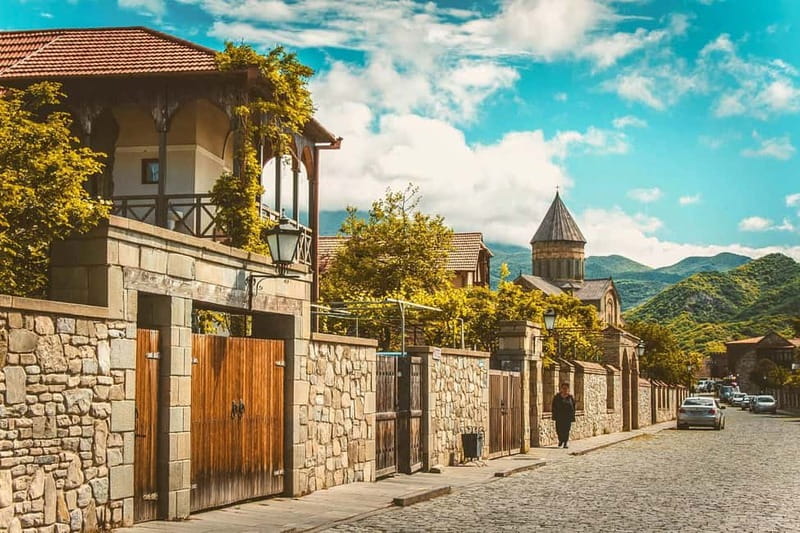
I would recommend it to first-time visitors who want a practical introduction to Mtskheta and Georgian Christianity. It is also a good fit for anyone who values major monuments, guided context, and a simple half-day plan.
History and architecture fans will get the most from Jvari and Svetitskhoveli. Religious sites are the main event, so you should be comfortable visiting active Georgian Orthodox churches and monasteries.
I would be more cautious if your ideal outing includes long walks, local shopping, a leisurely lunch, or lots of time for photography. You may feel rushed. The tour gives you the key places, but it does not promise much unstructured time.
Pack a scarf if you are a woman visiting the monasteries. Keep your phone handy for meeting instructions, but do not let the screen distract you from the guide or the views. Since food and drinks are not included, plan accordingly.
Booking is flexible: you can cancel up to 24 hours ahead for a full refund, and the reserve-now, pay-later option lets you hold a place without paying immediately.
Should you book it?
Book this tour if you want Mtskheta’s major monuments in four efficient hours and care more about history than free time. Jvari’s hilltop view, Svetitskhoveli’s sacred traditions, and Samtavro’s royal connections form a strong introduction to Georgia’s early Christian story.
Skip it, or choose a longer option, if wandering the town, eating locally, and browsing shops matter as much as the churches. The tour is good value for a focused overview, but it is not a relaxed day in Mtskheta. Keep your expectations practical, confirm meeting details, and judge the transport and guide on the day.
FAQ
Where does the tour meet?
The meeting point is Kote Abkhazi Street 44.
How long does the Mtskheta tour last?
The tour lasts four hours.
How much does the tour cost?
The listed price is $41 per person.
Which languages are available?
Live tour commentary is available in English and Russian.
What sights are included?
The tour visits Mtskheta, Jvari Monastery, Svetitskhoveli Cathedral, Samtavro Monastery complex, and a Georgian wine tasting stop.
Is food included?
No. Food and drinks are not included.
Do women need to bring a scarf?
Yes. Women need a scarf to cover their heads when visiting the monastery.
Can I cancel the tour?
Yes. You can cancel up to 24 hours in advance for a full refund.
Do I have to pay when I book?
No. The reserve-now, pay-later option allows you to book without paying immediately.
Just added near Tbilisi
- Wine Tasting feel the Difference of Qvevri or Classical Wine★ 4.4 · 10 reviews
- Walking Tour in Old Tbilisi – Group Tour★ 4.5 · 8 reviews
- From Tbilisi: Kakheti and Kazbegi 2-Day 4X4 Jeep Tour pack★ 5.0 · 6 reviews
- Tbilisi: Vintage Fashion and Secondhand Thrifting Tour★ 5.0 · 11 reviews
- Uforgatable Kakheti Tour with wine tasting – in Georgia★ 4.9 · 5 reviews
- From Tbilisi: Uplistsikhe Caves and Mtskheta Town Day tour★ 5.0 · 2 reviews
- Tbilisi Airport to Gudauri, Bakuriani, Batumi, Tbilisi★ 5.0 · 3 reviews
- Private Adorable City Tour of Tbilisi★ 5.0 · 3 reviews
Mtskheta and Jvari Tours, compared.
Mtskheta, Jvari, Gori and Uplistsikhe Day Tour
Read our review →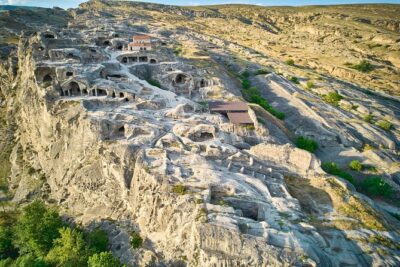
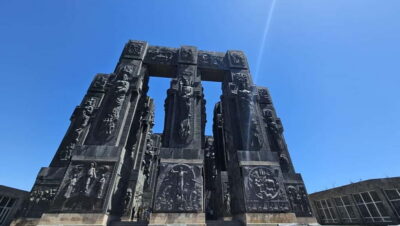
Mtskheta Jvari Bazaar, Chronicles of Georgia & Wine
Read our review →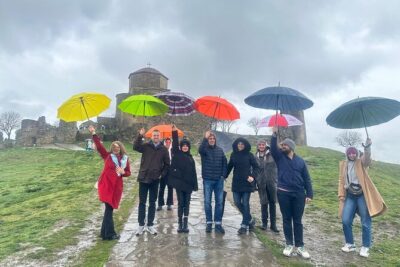
Mtskheta,Jvari,Bazaar,wine tasting,Chronicles of Georgia
Read our review →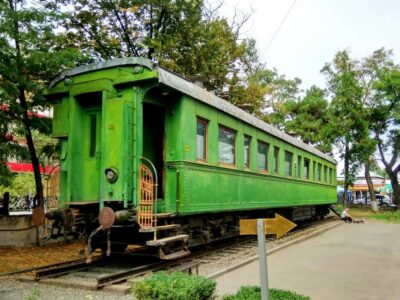
The Chronicles of Georgia, Jvari & Mtskheta Tour
Read our review →
Browse the lists this tour appears in