
Reviewed · MTSKHETA AND JVARI TOURS
One day tour in Mtskheta and Tbilisi
Two Georgian capitals, one busy day. This $35.90 tour gives you a practical way to see Tbilisi’s old quarters, hilltop Narikala Fortress, and the former capital of Mtskheta without arranging separate transport. I especially like the small group limit of 10 people and the mix of city streets, churches, viewpoints, and countryside landmarks. I also like that bottled water and snacks are included, though lunch is not, and eight hours can feel tight if you prefer lingering at each site.
The route packs in a great deal. You move from Freedom Square and the old city to the sulfur baths, then continue to Mtskheta’s Jvari Monastery and Svetitskhoveli Cathedral. The main consideration is pace: several stops last only 10 or 15 minutes, so this works best as a first look rather than a slow, in-depth exploration.
In This Review
- Why this day trip works
- What you get for $35.90
- Starting at Freedom Square
- Old walls, a puppet clock, and Anchiskhati Basilica
- Crossing the Mtkvari at the Bridge of Peace
- Churches and old-city streets
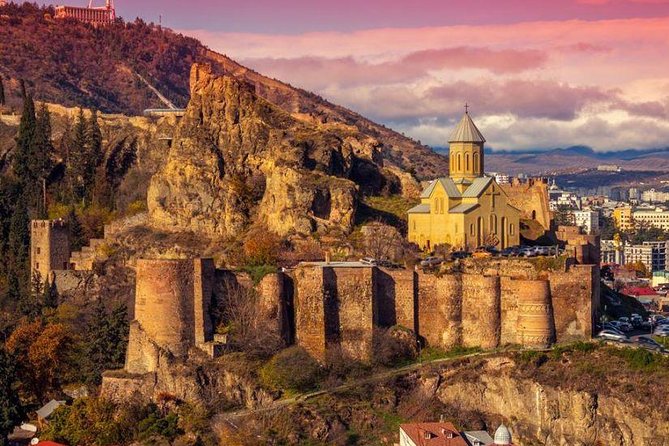
- Metekhi, Narikala, and Mother Georgia
- Abanotubani and the Leghvtakhevi waterfall
- Jvari Monastery above Mtskheta
- Walking Mtskheta’s old streets
- Svetitskhoveli Cathedral and the final chapter
- Who should book this tour?
- FAQ
- How long does the tour last?
- What is the price?
- Is hotel pickup available?
- What is included in the tour?
- Is lunch included?
- How many people can join the tour?
Why this day trip works
- Two capitals in one day: See modern Tbilisi and historic Mtskheta without booking two separate excursions.
- A compact group: The maximum group size is 10, which should make questions and guide commentary easier than on a large coach tour.
- A useful city route: The Tbilisi portion links Freedom Square, the old city wall, churches, bridges, baths, a waterfall, and Narikala.
- A strong historical finish: Jvari Monastery and Svetitskhoveli Cathedral give Mtskheta its UNESCO-listed appeal.
- Easy transport: Hotel pickup and an air-conditioned vehicle remove much of the day’s practical fuss.
- A praised guide experience: Guide Daviti has been singled out for being friendly, respectful, flexible, and good at adapting to individual interests.
What you get for $35.90
At $35.90 per person, this is priced as an efficient sightseeing day rather than a luxury tour. Your fare covers hotel pickup, an air-conditioned vehicle, a professional guide, bottled water, and snacks. It does not cover lunch, alcoholic drinks, or all fees and taxes.
The value comes mainly from the route. Tbilisi is spread across hills and riverbanks, while Mtskheta lies outside the capital. Seeing both independently would mean working out transport, deciding which landmarks to prioritize, and keeping an eye on the clock. Here, that planning is handled for you.
The small group size matters. A maximum of 10 people is much more manageable at churches and viewpoints than a full-size bus party. You can also ask about Georgian Orthodox traditions, the city’s changing names, or the stories tied to each church without trying to catch a guide’s voice from the back row.
Still, do not expect a relaxed food tour or a long stop at every monument. Lunch is on your own, and the sightseeing schedule keeps moving. Bring some Georgian lari for food and any extra admission or transport costs that may arise. The listed stops themselves have no admission charge, but the tour notes that all fees and taxes are not included.
More half-days at Mtskheta and Jvari:
- Tbilisi: Mtskheta, Jvari, Gori and Uplistsikhe Day Tour
★ 4.9 · 2,396 reviews - Day Trip to Mtskheta Gori and Uplistsikhe
★ 5.0 · 1,801 reviews - Tbilisi: Mtskheta Jvari Bazaar, Chronicles of Georgia & Wine
★ 5.0 · 1,088 reviews
Starting at Freedom Square
The day begins in central Tbilisi at Freedom Square, a useful place to understand the city’s political past. The square has changed names several times over roughly 200 years and was first laid out in the early 19th century with neo-classical and Moorish touches.
Its story also includes one of the boldest crimes connected with the city. In 1907, a bank robbery linked to Joseph Stalin took place here and reportedly secured the equivalent of about four million US dollars in today’s money. You have about 15 minutes, enough to hear the background and get oriented, but not enough for a long architectural study.
From here, the route includes Pushkin Street, named for the Russian poet and author Alexander Pushkin. The stop is brief, so treat it as part of the walking connection through central Tbilisi rather than a separate attraction.
Old walls, a puppet clock, and Anchiskhati Basilica
The old city wall ruins offer a quick reminder that Tbilisi was once a fortified settlement. The remains were discovered in 2012, and the scheduled stop lasts about 10 minutes. This is a small site, but it helps you picture the older city beneath the modern streets.
Next comes the Rezo Gabriadze Marionette Theater and its unusual clock tower. Built in 2010 beside the theater, the tower has an angel that appears each hour to strike the bell. A small puppet theater is inside, with performances of The Circle of Life at noon and 7pm.
The tour’s 10-minute visit may let you see the tower and hear about its shows, but the timing may not match either performance. If this puppet theater matters to you, check the departure time and ask whether the group schedule allows you to be there at noon or 7pm. Do not assume the performance is included.
Anchiskhati Basilica is one of Tbilisi’s oldest churches. It was built in the sixth century by Dachi, son of King Vakhtang Gorgasali. Its name comes from the icon of Anchi Cathedral in Klarjeti, now in Turkey, which was brought here in the 17th century. The icon is now held by Tbilisi’s Fine Arts Museum.
You have around 10 minutes here. Dress and behave respectfully inside Orthodox churches, where services and worship may continue during sightseeing.
Crossing the Mtkvari at the Bridge of Peace
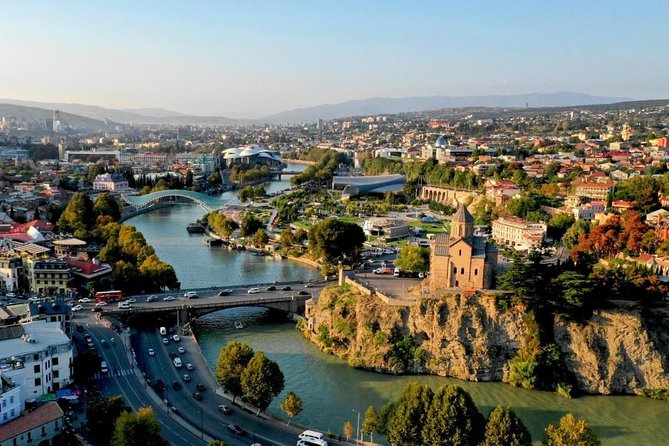
The Bridge of Peace gives you one of the tour’s clearest modern views. This pedestrian bridge crosses the Mtkvari River and links the old city area with Rike Park. You have about 15 minutes to take photographs and look back toward the riverfront.
Rike Park is a newer recreational space on the river’s left bank. It includes fountains, a climbing wall, a children’s maze, a large chess board, paths, and places to sit. The cable car to Narikala Fortress begins here, making the park an important transport point as well as a public space.
The park stop lasts only about 10 minutes, and the route later includes the aerial tramway. Ask the guide how the cable car fits into the schedule and whether its fare is included, since the tour information does not list that detail. The ride is a practical part of the route, not simply a scenic extra.
More Tbilisi days to weigh up
- Tbilisi: Day Trip to Kazbegi, Gudauri, Gergeti, and Ananuri
★ 4.9 · 3,203 reviews - Day Trip to Kakheti Wine Region Including 9 Wine Tastings
★ 5.0 · 2,774 reviews - Day Trip to Kazbegi and Gudauri
★ 5.0 · 2,009 reviews - Day Trip to Armenia Including Homemade Lunch
★ 5.0 · 1,162 reviews
Churches and old-city streets
Sioni Cathedral is in old Tbilisi and has been rebuilt many times after attacks by foreign invaders. Its present form is based on a 13th-century version, with later work from the 17th through 19th centuries.
For centuries, Sioni was the main Georgian Orthodox cathedral and the seat of the Catholicos-Patriarch of All Georgia. That role moved to Holy Trinity Cathedral after its consecration in 2004. The planned 15-minute stop gives you enough time to see the exterior and interior if conditions allow, while your guide explains the church’s place in Georgian religious life.
The group then passes through Shardeni Street. This narrow lane was once a trading center, covered by roofs and known as a dark row. It was reconstructed in 1981 and renamed for Jean Chardin, a French traveler who visited Georgia in the 17th century.
Today, Shardeni Street is known for bars and clubs. It is a quick contrast to the older churches nearby, showing how Tbilisi’s historic center now serves both local life and tourism.
Metekhi, Narikala, and Mother Georgia
Metekhi Cathedral sits in the historic Metekhi district on a cliff above the Mtkvari River. This is one of the most rewarding viewpoints in the city, and the church’s setting helps explain why this area was inhabited early in Tbilisi’s development.
The church has been destroyed and rebuilt several times. It suffered during the Mongol invasion, was later damaged by the Persians, and was rebuilt by Georgian kings in the 16th and 17th centuries. A further restoration came in the 19th century, when nearby fortifications were removed and replaced by a prison building.
The stop lasts about 15 minutes. Keep your camera ready, but also listen for the political and military story behind the site. Metekhi is not only a church visit. It is a high point from which Tbilisi’s river setting becomes easier to understand.
From Rike Park, the aerial tramway carries you toward Narikala Fortress. The ride offers broad views over the Mtkvari and the old city. The route description specifically promises time for the cable car and the fortress, but it does not state whether the tramway ticket is included, so clarify this before departure.
Narikala began as a Persian citadel in the fourth century, known then as Shuris-tsikhe. The Umayyads expanded it in the seventh century, and King David the Builder added to it later. The Mongols called it Narin Qala, meaning Little Fortress.
Much of what you see today dates from the 16th and 17th centuries. An earthquake damaged parts of the fortifications in 1827, and some sections were later demolished. The lower court contains St. Nicholas Church, rebuilt in 1996 and 1997 on the site of a 13th-century church destroyed by fire.
You have about 20 minutes at Narikala. That is enough for the main views and a short look around, but not a slow fortification walk. Wear shoes suitable for uneven ground and stay aware of the group’s return time.
Nearby, the 20-meter aluminum statue of Kartlis Deda, or Mother of Georgia, watches over the city from Sololaki Hill. Elguja Amashukeli designed the figure in 1958 for Tbilisi’s 1,500th anniversary. She holds a bowl of wine in her left hand for friends and a sword in her right for enemies.
The stop is only five minutes, so this is mainly a photo and viewpoint visit. It is a compact symbol of Georgian hospitality and self-defense, two ideas that appear often in the country’s national story.
Abanotubani and the Leghvtakhevi waterfall
Abanotubani is Tbilisi’s old bath district, known for its sulfur springs. According to local legend, King Vakhtang Gorgasali’s falcon fell near the hot springs, leading to the discovery that helped prompt the founding of a new capital.
You have around 15 minutes here. The tour gives you a look at the district, but it does not include a bath session. If you want to use one of the sulfur baths, plan that for another time, since this full-day route has no spare time built in.
A short walk leads to Leghvtakhevi Waterfall, which drops 22 meters within the bath district. Its name comes from the Georgian word leghvi, meaning fig, because fig trees once grew around the area.
The waterfall stop lasts about 10 minutes. It is a pleasant change from churches and city squares, but the time is brief. Take the photograph, listen to the explanation, and be ready to continue.
Jvari Monastery above Mtskheta
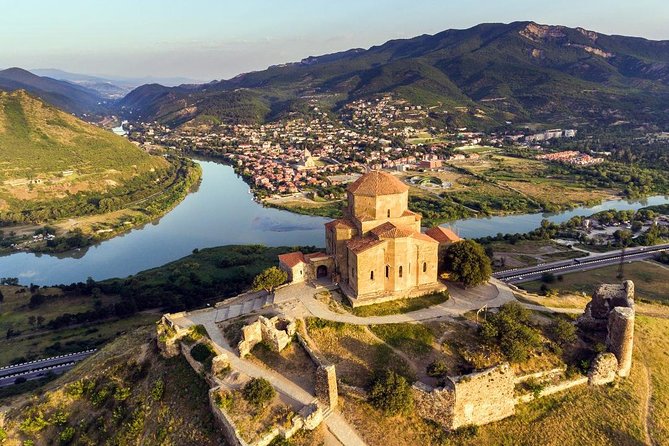
The journey then leaves Tbilisi for Mtskheta, Georgia’s former capital and a major religious center. Jvari Monastery sits on a rocky hill above the meeting point of the Mtkvari and Aragvi rivers, with views toward Mtskheta below.
Jvari is a sixth-century Georgian Orthodox monastery and a UNESCO World Heritage site. Its importance reaches back to the conversion of Georgia to Christianity. King Mirian III is said to have raised a large wooden cross here after accepting Christianity, and a small church was built beside it in the second half of the sixth century by Guaram, ruler of Kartli.
The hilltop setting is a major reason to value this stop. You can see the river junction, the old capital, and the surrounding countryside from one place. The visit lasts about 20 minutes, so the guide’s explanation will help you understand what you are seeing before the group moves on.
Walking Mtskheta’s old streets
In Mtskheta, you have about 40 minutes to explore the city museum reserve. Expect cobbled streets, old balconies, and a quieter scale than central Tbilisi. This is the part of the day where you can slow down slightly, although 40 minutes still does not allow for a full museum visit and a long meal.
Mtskheta served as the capital of the Kingdom of Iberia before Tbilisi took that role. It remains an important religious center, and its old town forms part of the UNESCO-recognized area.
Use this time to look beyond the main cathedral. The balconies and street layout provide a sense of an old Georgian town, while the cathedral gives the visit its main focus. Since lunch is not included, this is also the logical point to ask about food timing, though the schedule may not allow a full restaurant meal.
Svetitskhoveli Cathedral and the final chapter
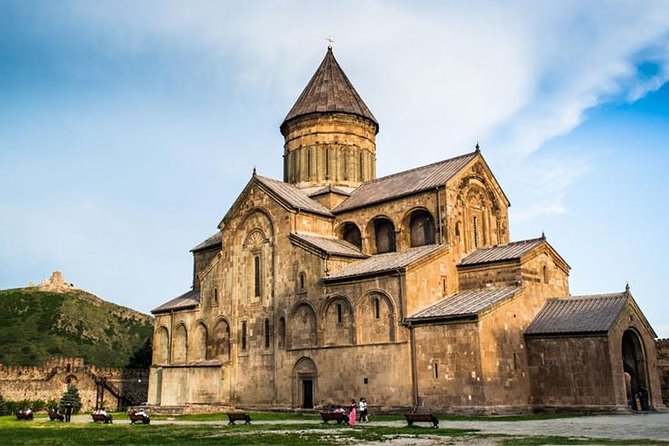
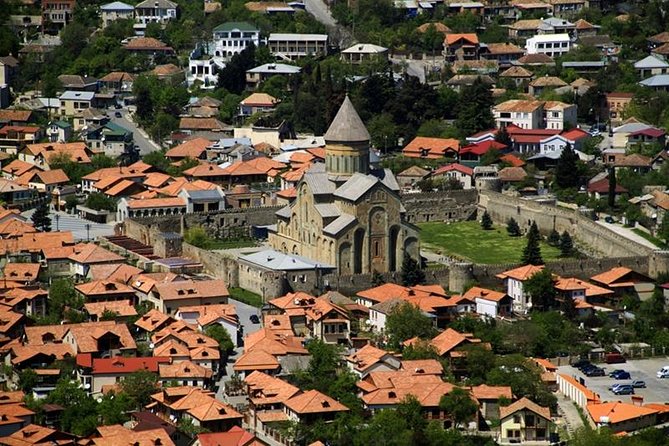
Svetitskhoveli Cathedral is the major visit in Mtskheta. This Early Medieval church is recognized by UNESCO and is currently the second-largest church building in Georgia, after Holy Trinity Cathedral in Tbilisi.
The cathedral carries a powerful Georgian religious legend. Elioz, a citizen of Mtskheta, is said to have found the tunic of Jesus Christ in Jerusalem and brought it home. His sister Sidonia died after touching it and was buried wrapped in the tunic. A cedar of Lebanon then grew over her grave, and the site became tied to the cathedral’s founding story.
You have about 30 minutes here, the longest church visit of the day. That gives you time to study the structure, hear the story, and take in the atmosphere of one of Georgia’s most important religious places. As with the other churches, respectful clothing and quiet behavior are appropriate.
The tour ends after this visit, returning you to Tbilisi or your drop-off point as arranged. Since the full experience lasts about eight hours, expect a full but efficient day.
Who should book this tour?
I would choose this tour if you are visiting Georgia for the first time and want a guided introduction to both Tbilisi and Mtskheta. It suits you especially well if you value convenience, prefer a small group, and want historical context rather than simply photographing landmarks.
The route is also a good fit if you have limited time in Tbilisi. You see the old city, river views, Narikala, the sulfur bath district, Jvari, and Svetitskhoveli in one outing.
I would look elsewhere if you want long museum visits, extended time inside churches, a leisurely lunch, or a flexible photography day. The schedule is packed, and several stops are short. Ask in advance about the aerial tramway fee, lunch timing, and pickup details. Free cancellation is available up to 24 hours before the start time, while poor weather or too few bookings can lead to a rescheduled tour or full refund.
FAQ
How long does the tour last?
The experience lasts approximately eight hours.
What is the price?
The listed price is $35.90 per person.
Is hotel pickup available?
Yes. Hassle-free hotel pickup is offered.
What is included in the tour?
The tour includes bottled water, snacks, an air-conditioned vehicle, and a professional guide.
Is lunch included?
No. Lunch and alcoholic beverages are not included.
How many people can join the tour?
The maximum group size is 10 people.
Just added near Tbilisi
- Wine Tasting feel the Difference of Qvevri or Classical Wine★ 4.4 · 10 reviews
- Walking Tour in Old Tbilisi – Group Tour★ 4.5 · 8 reviews
- From Tbilisi: Kakheti and Kazbegi 2-Day 4X4 Jeep Tour pack★ 5.0 · 6 reviews
- Tbilisi: Vintage Fashion and Secondhand Thrifting Tour★ 5.0 · 11 reviews
- Uforgatable Kakheti Tour with wine tasting – in Georgia★ 4.9 · 5 reviews
- From Tbilisi: Uplistsikhe Caves and Mtskheta Town Day tour★ 5.0 · 2 reviews
- Tbilisi Airport to Gudauri, Bakuriani, Batumi, Tbilisi★ 5.0 · 3 reviews
- Private Adorable City Tour of Tbilisi★ 5.0 · 3 reviews
Mtskheta and Jvari Tours, compared.
Mtskheta, Jvari, Gori and Uplistsikhe Day Tour
Read our review →
Mtskheta Jvari Bazaar, Chronicles of Georgia & Wine
Read our review →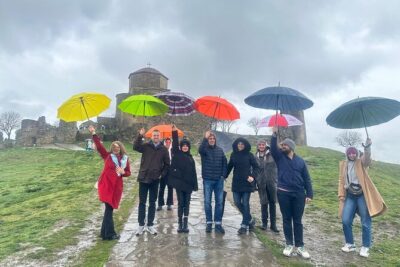
Mtskheta,Jvari,Bazaar,wine tasting,Chronicles of Georgia
Read our review →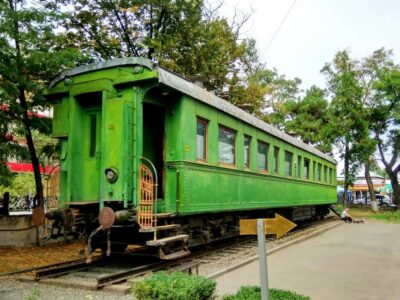
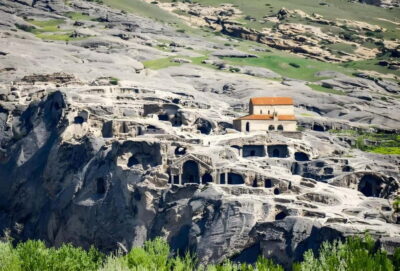
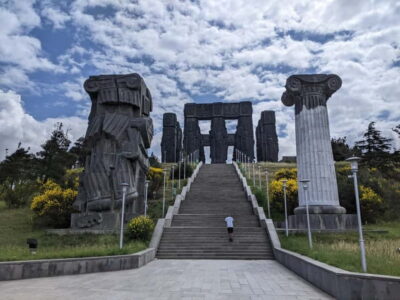
The Chronicles of Georgia, Jvari & Mtskheta Tour
Read our review →
Browse the lists this tour appears in