
Reviewed · CABLE CAR AND FUNICULAR RIDES
Tbilisi Walking Tour with Cable Car, Wine Tasting & Bread Bite
Tbilisi rewards curious walkers. This four-hour private tour links Old Town sights with a cable-car ride to Mother of Kartli, then adds Georgian wine and fresh bread for a taste of local life. I like the personal format and the way the route covers both major monuments and small historic churches. The included wine tasting is another welcome touch at $77.50 per person.
The main drawback is pace. You cover many stops in four hours, with stairs, uneven ground, and several brief church visits. Church dress rules also matter: women need a head scarf and dress or skirt, while men need long trousers.
A guide named George received especially warm praise for balancing sightseeing with rest breaks and good time management. That is useful here, since this is not a slow, aimless stroll. It is a brisk introduction to Tbilisi, with a private vehicle, a cable car, a little food, and plenty of history packed into one morning or afternoon.
In This Review
- Key points to know before booking
- Why this Tbilisi tour works well for a first visit
- Old Town Tbilisi: a crossroads in city form
- Metekhi Cathedral and Vakhtang Gorgasali
- Cable car to Mother of Kartli
- Narikala Fortress and the city below
- Sulfur baths, Love Lock Bridge, and Leghvtakhevi Waterfall
- Four historic churches in a compact walk
- Rezo Gabriadze’s clock tower and the Bridge of Peace
- Wine tasting and bread: small extras with real value
- Price, pace, and who gets the best value
- Should you book the Tbilisi Walking Tour?
- FAQ
- How long does the Tbilisi walking tour last?
- Is this a private tour?
- Is hotel pickup available?
- Is the cable-car ride included in the price?
- Is Georgian wine included?
- Is food included on the tour?
- What should I wear to the churches?
- Is the boat ride on the Mtkvari River included?
- Can I cancel for a full refund?
Key points to know before booking
- A private four-hour route gives your group the guide’s full attention, with morning and afternoon departure choices.
- The cable car to Mother of Kartli provides some of the best broad views over Old Tbilisi and the Kura River.
- Wine and bread are included, giving the tour a small but meaningful taste of Georgian hospitality.
- Narikala Fortress and the sulfur-bath district show two very different sides of the city, one defensive and elevated, the other tucked into a narrow ravine.
- Church visits require modest clothing, and scarves and coverings may be available at entrances.
- The route suits first-time visitors, but comfortable shoes are essential because of stairs and varied surfaces.
Why this Tbilisi tour works well for a first visit
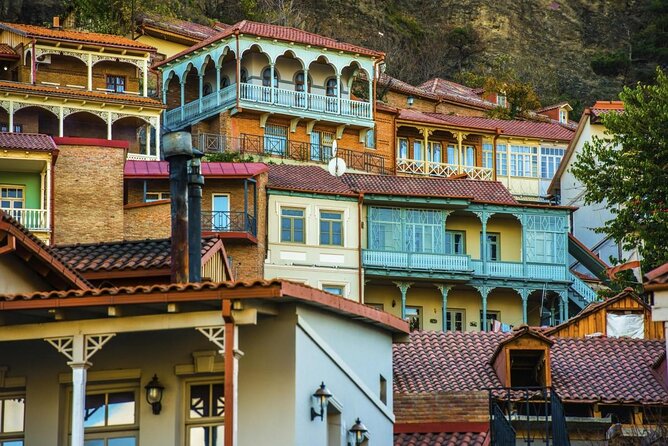
Tbilisi is a city of contrasts. Medieval churches sit near modern glass structures. Old balconies lean over narrow lanes, while the Kura River cuts through the center below steep hills. The city’s position between Europe and Asia has made it a prize, a crossroads, and a battleground for centuries.
That complicated past is visible in the buildings. You may see medieval stonework, neoclassical facades, Art Nouveau details, Soviet-era construction, and newer architecture within the same outing. A good guide helps connect those pieces instead of treating the city as a string of unrelated photo stops.
This tour is particularly useful if you have only a short stay in Tbilisi. It gathers the main sights in the historic center and adds the cable car, which saves energy on one steep section. Pickup is offered, and the air-conditioned vehicle helps link the walking portions without making the whole experience a long uphill march.
The private format is valuable. Your group does not need to wait for strangers, and you can ask questions about churches, food, architecture, or Georgia’s past as you go. It also makes rest breaks easier to arrange. That matters in summer, when Tbilisi’s hills and stone streets can feel tiring.
More Walking Tours in Tbilisi
- Tbilisi Walking Tour Including Cable Car and Traditional Bakery
★ 5.0 · 1,310 reviews - Tbilisi: City Highlights Guided Walking Tour
★ 4.9 · 1,114 reviews - Tbilisi:Evening Walking & Talking Tour with Wine & Boat Ride
★ 5.0 · 572 reviews
Old Town Tbilisi: a crossroads in city form
The Old Town is the heart of the experience. Tbilisi was founded in the fifth century by Vakhtang I of Iberia and grew because it sat near major routes between Europe and Asia. Its location brought trade, wealth, invasion, and repeated rebuilding.
I like starting here because the city’s story is easier to understand on foot. You can see how the old center follows the shape of the river and hills, while the mixed architecture reflects different rulers and eras. The route does not charge an admission fee for the Old Town, so the value comes from the guide’s explanation and the connections between the sights.
Do not expect a quiet museum-like district. Streets can be uneven, and the old center includes slopes and stairs. Wear shoes with a firm sole. The tour description allows four hours for the entire experience, but this stop is listed as the main block of time, so your guide may use it to connect several nearby sights rather than pause at every building.
Metekhi Cathedral and Vakhtang Gorgasali
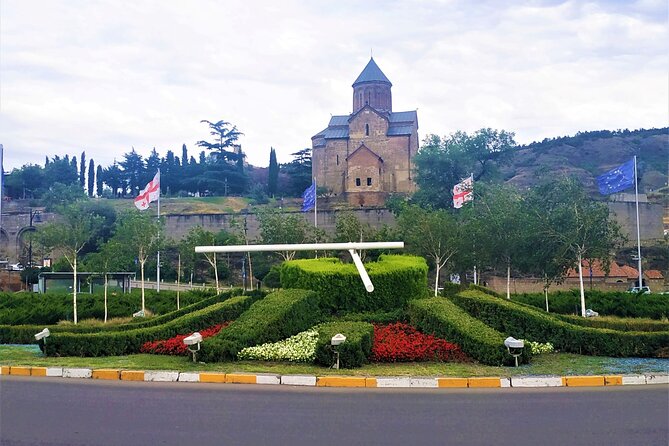
Metekhi Cathedral sits on a rocky rise above the Kura River. The church was built under King Demetrius II in the late 13th century and has been damaged and restored several times.
Its story is not only religious. During Russian rule, the church lost its religious function and became a military base. The surrounding citadel was demolished in 1819 and replaced by a jail that remained until the Soviet period. The statue of King Vakhtang Gorgasali, erected in 1961, adds a strong historical figure to the view.
The stop lasts about 20 minutes and has no admission charge. That is enough for an explanation, exterior views, and a quick look inside if conditions allow. The elevated setting helps you see how tightly Tbilisi is built around the river.
Cable car to Mother of Kartli
The cable car is one of the tour’s most useful inclusions. It takes you toward the Mother of Kartli monument, avoiding a demanding climb and opening up wide views over Old Tbilisi.
Mother of Kartli was erected in 1958 for Tbilisi’s 1,500th anniversary. The 20-meter aluminum woman wears traditional dress. In one hand she holds a bowl of wine for friends, and in the other she carries a sword for enemies. It is a simple image with a clear message: welcome and defense belong together in Georgia’s national character.
The ride itself is short, with about 20 minutes allocated to this part of the route. The real payoff is the view. You can look across the old rooftops, the river, and the hills that shape the city. This is one reason the tour works better than a basic street walk. You get a sense of Tbilisi’s layout instead of seeing only the next alley.
The cable-car ticket is included. That is important because the ride is not an optional extra within the tour. At the end, you may also take a boat on the Mtkvari River for an additional charge, but that boat trip is separate.
More Wine Tours in Tbilisi
- Day Trip to Kakheti Wine Region Including 9 Wine Tastings
★ 5.0 · 2,774 reviews - From Tbilisi: Kakheti Wine Region Tour with 9 Wine Tastings
★ 4.9 · 2,541 reviews - Tbilisi: Kakheti Wine Region Tour with 10 Wine Tastings
★ 5.0 · 2,160 reviews - Tbilisi: Mtskheta Jvari Bazaar, Chronicles of Georgia & Wine
★ 5.0 · 1,088 reviews
Narikala Fortress and the city below
Narikala Fortress occupies the hill above the old center. Its earliest form dates to the fourth century, when it was a Sasanian citadel called Shuris-tsikhe, or Invidious Fort. King David the Builder expanded it in the 11th and 12th centuries, and the Mongols later gave it the name Narin Qala, meaning Little Fortress.
Much of what you see today comes from the 16th and 17th centuries. An earthquake damaged the fortress in 1827, so this is not a perfectly preserved medieval stronghold. Its appeal is the combination of weathered walls, open sky, and commanding views.
The stop is about 20 minutes and free to enter. That is enough to explore a section and take photographs, but not enough for a long wander through every corner. The ground can be rough, and stairs are part of the route. If you have limited mobility, ask about the walking conditions before booking.
I especially like this stop for orientation. From above, Tbilisi’s old streets, river, bridges, and surrounding hills make more sense. The guide can point out how the old city grew in a narrow corridor between water and slopes.
Sulfur baths, Love Lock Bridge, and Leghvtakhevi Waterfall
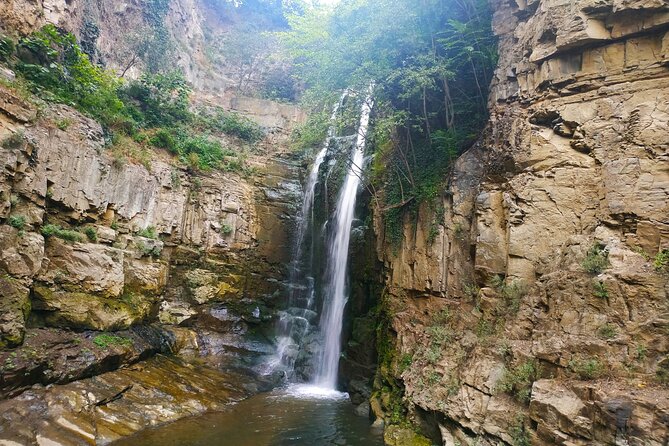
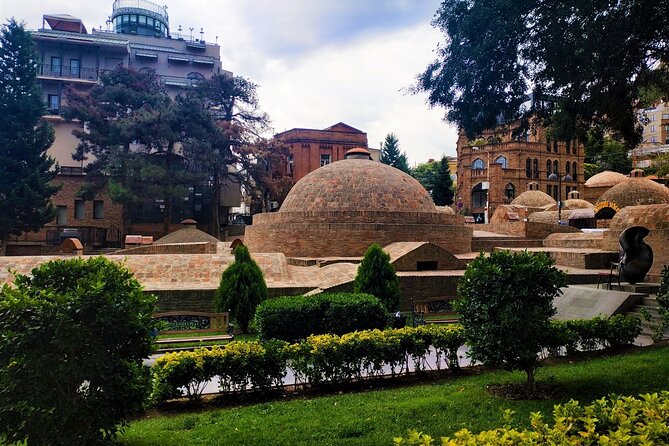
After the fortress, the route moves toward the sulfur-bath district. Tbilisi’s name is linked to its warm springs, and the bath water comes from underground at roughly 40 to 50 degrees Celsius. The water contains sulfur and has long been associated with treatments for skin problems, dry scalp, aching joints, digestion, and insomnia.
This tour does not include a bath session. You visit the area and learn about the springs, then continue to the Love Lock Bridge and Leghvtakhevi Waterfall. The waterfall flows from the Tbilisi Botanical Garden into a narrow urban ravine, creating a surprisingly natural pause in the center.
The stop is scheduled for about 20 minutes. That makes it a quick look, not a full spa experience or botanical-garden visit. Still, it adds variety to the day. You move from high defensive walls to warm springs, stone paths, and falling water within a short distance.
The route here may include stairs and uneven sections. Take care after rain, and do not wear slippery shoes. The contrast between the baths and waterfall is one of the tour’s more memorable combinations.
Four historic churches in a compact walk
The tour visits Jvaris Mama, Sioni Cathedral, Rezo Gabriadze Marionette Theater, and Anchiskhati Basilica in the old center. Each church stop lasts about 10 minutes, so you should think of these as focused introductions rather than long religious or architectural visits.
Jvaris Mama means Father of the Cross. The original church was linked to King Vakhtang Gorgasali and traditions surrounding Saint Nino. The current building dates to the 16th century, though it has been destroyed and restored more than once. Until 1921, it belonged to the Jerusalem Patriarchate and helped support the Jerusalem Cross Church.
Sioni Cathedral takes its name from Mount Zion in Jerusalem. Its roots reach back to the sixth or seventh century, while the present structure contains work from several periods. King David the Builder rebuilt it in 1112, and the cathedral remained the main Georgian Orthodox cathedral until Holy Trinity Cathedral was consecrated in 2004.
Anchiskhati Basilica is the oldest surviving church in Tbilisi, dating to the sixth century. It was built by King Dachi and later took its current name after the Anchiskhati icon was moved to Tbilisi in the 17th century for protection. The basilica has been rebuilt more than once, and its interior combines older and later work.
These churches require respectful clothing. Women should bring a head scarf and a dress or skirt, while men should wear long trousers. Scarves and coverings may be available near the entrances, but I would not rely on that. Pack a light scarf and dress modestly from the start.
The churches can feel rushed if you want detailed art history. On the other hand, the short visits let you see several important places without giving up the rest of the route. If one church particularly interests you, tell your guide so you can use your private format well.
Rezo Gabriadze’s clock tower and the Bridge of Peace
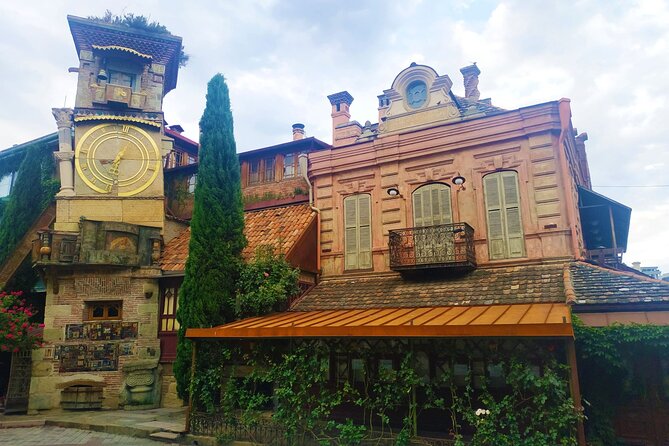
Rezo Gabriadze Marionette Theater adds a playful note to a route otherwise heavy with fortresses and churches. Gabriadze, born in 1936, is a theater and film director, writer, painter, and sculptor. He founded the theater in 1981, and the distinctive clock tower was added in 2011.
On the hour, a window opens and an angel figure strikes a bell. A small screen below presents a symbolic cycle of life, from meeting and marriage to birth and funeral. The performance is brief, so check the timing with your guide if seeing it matters to you.
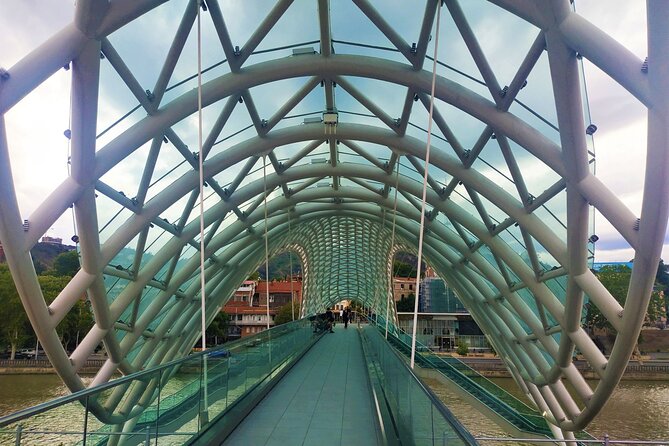
The final listed stop is the Bridge of Peace, a 150-meter modern bridge over the Mtkvari River. Designed by Italian architect Michele De Lucchi, it has a marine-animal-inspired form and links the old center with newer parts of Tbilisi.
The bridge is a good ending because it shows how the city continues to change. After so many old churches and ruins, the modern structure reminds you that Tbilisi is not frozen in its past.
Wine tasting and bread: small extras with real value
Georgian wine is not just a drink added to the schedule. Wine has a long place in Georgian culture, and the Mother of Kartli monument uses a bowl of wine as a symbol of friendship. Sampling it during the tour gives that symbol a practical connection.
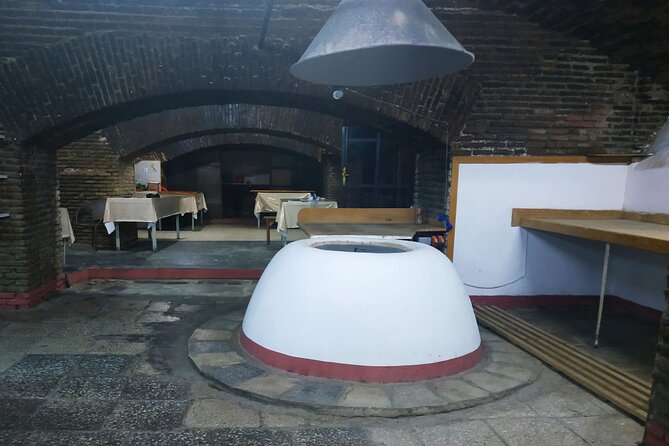
The wine tasting is included in the $77.50 price, with no extra charge. Bread is included too. The experience is called a bread bite rather than a full meal, so you should not book it as lunch. It is best treated as a short food break that adds local flavor to the sightseeing.
I like these extras because they break up the monuments. A four-hour tour can become a march from one stone building to the next. Wine and bread make the day feel more connected to Georgian daily life, even though the main focus remains history and views.
The legal drinking age in Georgia is 18. If you do not drink, the tasting is only one small part of the outing, and the tour still offers plenty of architecture and scenery.
Price, pace, and who gets the best value
At $77.50 per person, this is not the cheapest way to walk around Tbilisi. The price makes more sense for a private group that values a dedicated guide, pickup, air-conditioned transport, the included cable-car ride, and wine tasting.
You also save planning time. Instead of working out how to connect Metekhi, Narikala, the sulfur baths, four churches, the theater clock, and the Bridge of Peace, you follow one organized route. The vehicle is useful between walking sections, especially in heat or after the fortress.
The tradeoff is depth. Ten minutes at a church will not satisfy someone who wants an extended religious-art tour. The brisk schedule is best for first-time visitors who want a strong overview, not for someone spending a week studying every corner of Old Tbilisi.
The private setup suits couples, families, and small groups with shared interests. It is also helpful if some people need occasional rest. Most people can participate, but the various surfaces and stairs mean you should be honest about your walking ability before booking.
Morning and afternoon departures give you some control over your day. The best choice depends on your wider schedule and the weather. The tour requires good weather, and poor conditions can lead to a new date or a full refund.
Should you book the Tbilisi Walking Tour?
Book it if you want a well-packed first look at central Tbilisi, especially if you value private guiding and broad views more than long visits inside individual churches. The cable car, Narikala Fortress, sulfur district, wine tasting, and bread make the route varied.
Skip it if you prefer a slow walk with long museum stops, or if stairs and uneven ground are a serious problem. You should also prepare proper church clothing before you go.
For most first-time visitors with four hours to spare, this is a practical introduction with genuine local touches. Bring comfortable shoes, a scarf, modest clothing, and an appetite for a small taste of Georgia.
FAQ
How long does the Tbilisi walking tour last?
The tour lasts approximately four hours.
Is this a private tour?
Yes. Only your group participates, so the guide can give your party personal attention.
Is hotel pickup available?
Pickup is offered, though the provided information does not specify the exact pickup locations.
Is the cable-car ride included in the price?
Yes. The aerial tramway ticket is included.
Is Georgian wine included?
Yes. You can sample Georgian wine at no extra cost.
Is food included on the tour?
A bread bite is included. The information does not describe it as a full meal.
What should I wear to the churches?
Women need a head scarf and a dress or skirt. Men should not wear short trousers. Scarves and suitable coverings may be available near church entrances.
Is the boat ride on the Mtkvari River included?
No. The boat ride is an optional activity at the end of the tour and costs extra.
Can I cancel for a full refund?
Yes, if you cancel at least 24 hours before the experience starts. Cancellations made less than 24 hours in advance are not refunded, and poor weather may result in a different date or a full refund.
More Georgian Wine Tasting near Tbilisi
- Kakheti Wine Region: Signagi and Bodbe Tour with 10 Wine Tastings
★ 5.0 · 1,019 reviews - Tbilisi:Mtskheta,Jvari,Bazaar,wine tasting,Chronicles of Georgia
★ 5.0 · 730 reviews - Tbilisi: Evening Walking Tour with Wine & Boat Ride Options
★ 5.0 · 407 reviews - Kakheti;City of Love Sighnaghi, Bodbe. KTW. Wine House Group tour
★ 5.0 · 376 reviews
More Cable Car Rides in Tbilisi
- Tbilisi: Old Town Highlights w/ 5 Tastings & Cable Car Ride
★ 5.0 · 180 reviews - Tbilisi: Old and New City Guided Tour with 2 Cable Car Rides
★ 5.0 · 176 reviews - Tbilisi: Sightseeing Tour, Wine or Beer Tasting, & Cable Car
★ 5.0 · 26 reviews - Full Day Tbilisi City Tour with Wine Tasting & Cable Car Ride
★ 5.0 · 18 reviews
Just added near Tbilisi
- Wine Tasting feel the Difference of Qvevri or Classical Wine★ 4.4 · 10 reviews
- Walking Tour in Old Tbilisi – Group Tour★ 4.5 · 8 reviews
- From Tbilisi: Kakheti and Kazbegi 2-Day 4X4 Jeep Tour pack★ 5.0 · 6 reviews
- Tbilisi: Vintage Fashion and Secondhand Thrifting Tour★ 5.0 · 11 reviews
- Uforgatable Kakheti Tour with wine tasting – in Georgia★ 4.9 · 5 reviews
- From Tbilisi: Uplistsikhe Caves and Mtskheta Town Day tour★ 5.0 · 2 reviews
- Tbilisi Airport to Gudauri, Bakuriani, Batumi, Tbilisi★ 5.0 · 3 reviews
- Private Adorable City Tour of Tbilisi★ 5.0 · 3 reviews
Cable Car and Funicular Rides, compared.

Tbilisi Walking Tour Including Cable Car and Traditional Bakery
Read our review →

Old Town Highlights w/ 5 Tastings & Cable Car Ride
Read our review →
Old and New City Guided Tour with 2 Cable Car Rides
Read our review →
Chiatura Tour with Katskhi Pillar & Cable Car Experience
Read our review →
Sightseeing Tour, Wine or Beer Tasting, & Cable Car
Read our review →
Full Day Tbilisi City Tour with Wine Tasting & Cable Car Ride
Read our review →
Tbilisi Walking Tour Including Cable Car and Wine Tasting
Read our review →Browse the lists this tour appears in