
Reviewed · GORI AND STALIN MUSEUM TOURS
Uplistsikhe-Borjomi-Gori-Mtskheta
Georgia packs a lot into one day. This private tour links hilltop churches, mineral springs, Soviet history, an ancient cave town, and the country’s old religious center in about seven to nine hours. It is a useful way to see several major sights beyond Tbilisi without arranging separate transport.
I like the private format for up to three people, especially because the long route can be shaped around your group’s pace. I also like the mix of places: Jvari and Svetitskhoveli cover Georgia’s Christian traditions, while Borjomi, Gori, and Uplistsikhe bring in nature, Soviet history, and archaeology. The main drawback is time. Five stops spread across a large area mean short visits, and Borjomi’s cable car or longer park walk may be difficult to fit in.
Guides connected with this experience include Mamuka, George, Mamu, Ani, and Anna. The strongest praise centers on their friendly service, clear communication, help with restaurants and shopping, and ability to explain local history. If you want a relaxed private drive rather than a large coach, this is a strong one-day introduction to central Georgia.
In This Review
- Key points to know before booking
- Why this route works for a first trip from Tbilisi
- Jvari Church and the meeting of two rivers
- Borjomi-Kharagauli National Park on the road south
- Borjomi Central Park and the famous mineral water
- Gori and the Stalin Museum
- Uplistsikhe, a rock-hewn town from around 1000 BC
- Svetitskhoveli Cathedral in old Mtskheta
- The private format and the value of $179
- Guide service and the human side of the day
- Timing, comfort, and what to prepare
- Who should book this Georgia day tour?
- Final verdict: a strong overview with a fast pace
- FAQ
- How much does the tour cost?
- How long does the tour last?
- What time does the tour start?
- Where does the tour begin and end?
- Is hotel pickup offered?
- Which places are visited?
- Are admission tickets included?
- Can I cancel for a full refund?
Key points to know before booking
- Five major sights in one day: Jvari Church, Borjomi Central Park, the Stalin Museum, Uplistsikhe Cave Town, and Svetitskhoveli Cathedral.
- Private price of $179 per group: The rate covers up to three people, not each individual, which can make it good value for a small party.
- A driver who also guides: The service is designed around local assistance, historical explanation, and a friendly atmosphere.
- Borjomi admission extras cost more: The park visit is included in the route, but the cable car and other paid elements are not included.
- A demanding but rewarding schedule: Expect roughly seven to nine hours, beginning at 9:00 a.m. and ending back at the meeting point in Tbilisi.
- Free cancellation with a clear deadline: Cancel at least 24 hours before the start time for a full refund.
Why this route works for a first trip from Tbilisi
The appeal is variety. You are not spending the day looking at five churches or five archaeological sites. Instead, the route moves through different chapters of Georgian life.
You begin above Mtskheta at Jvari, where two rivers meet below. You then pass through the forests and mountain scenery of Borjomi-Kharagauli National Park, stop for the famous mineral water in Borjomi, and continue to Gori, the birthplace of Joseph Stalin. Uplistsikhe brings you into a rock-hewn settlement that began around 1000 BC. The day closes at Svetitskhoveli Cathedral, one of Georgia’s most important religious sites.
I like this range because it gives you useful context. Georgia is not only monasteries and mountain views. It is also ancient pagan and Christian history, Soviet memory, mineral springs, and modern national identity.
The trade-off is that the tour favors breadth over depth. The stated stop times add up to less than three hours, not counting driving, meals, queues, or optional activities. That means you will see the key sights, but you should not expect a slow archaeological study or a long forest walk.
More Gori and Stalin Museum runs:
- Tbilisi: Mtskheta, Jvari, Gori and Uplistsikhe Day Tour
★ 4.9 · 2,396 reviews - Day Trip to Mtskheta Gori and Uplistsikhe
★ 5.0 · 1,801 reviews - From Tbilisi : Mtskheta, Jvari, Gori & Uplistsikhe Day Trip
★ 4.8 · 432 reviews
Jvari Church and the meeting of two rivers
The first stop is Jvari Church, reached soon after leaving Tbilisi. You get about 30 minutes here, with no admission fee.
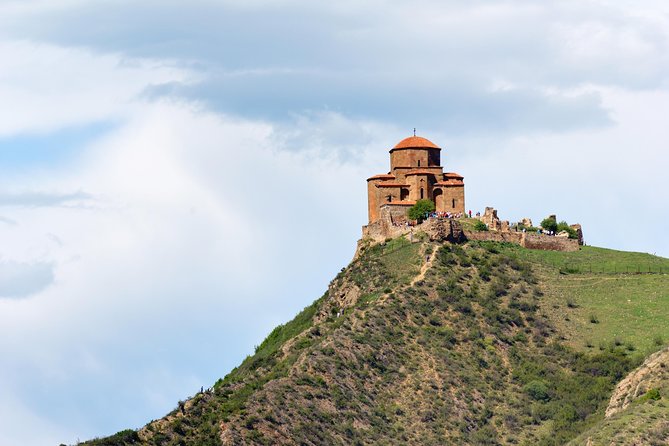
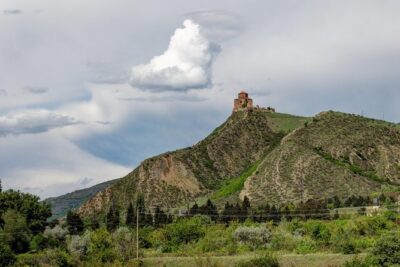
Jvari is valued as much for its position as for its religious importance. From the monastery, you can look over Mtskheta and see the Aragvi and Kura, also called the Mtkvari, joining below. Wave-like mountains frame the view, giving you an immediate sense of why Mtskheta became such an important center.
The site dates back to the early Christian period in Georgia. Construction began in the fourth century, soon after Georgia adopted Christianity, while the large main church was built later, in the eleventh century. That long timeline makes the stop more than a quick photo break. You are seeing a place tied to the early formation of Georgian Christian culture.
Thirty minutes is enough to walk around, take in the panorama, and hear the basic story. It is not enough for a slow visit if you want extended time inside the church or a careful look at every architectural feature. I would use this stop to focus on the view and the meeting of the rivers, then let the guide fill in the historical setting.
Borjomi-Kharagauli National Park on the road south
The route continues through Borjomi-Kharagauli National Park. You are not given a dedicated hiking excursion here, but the drive itself provides a look at one of Europe’s largest protected areas.
This section matters because it breaks up the monuments. After the stone churches around Mtskheta, you move through Georgia’s natural scenery before reaching Borjomi. The park is a reminder that the country’s appeal is not limited to old buildings.
Since the tour is private, you can ask the guide about the scenery as you go. Still, do not book this outing expecting a national park trek. The listed schedule gives you a short visit in Borjomi Central Park, and the full route already covers a great deal of ground.
Borjomi Central Park and the famous mineral water
Borjomi Central Park is the day’s main nature stop. The town sits about 800 to 900 meters above sea level, and its identity is closely tied to natural mineral water.
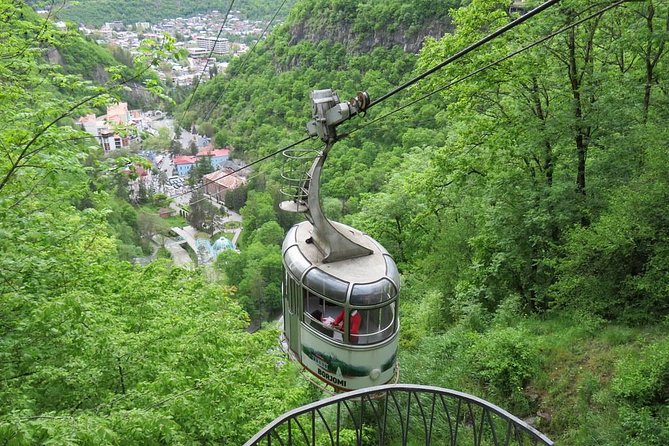
You can drink Borjomi water in the park, walk through the grounds, and see a waterfall. You may also take a cable car up to a plateau and lake above the town for views over Borjomi. The cable car is not included in the tour price, so plan on an extra charge if you want that option.
The stated visit lasts about 45 minutes, with admission not included. That is enough for a taste of the park and the mineral-water tradition, but the timing becomes tight if you want to walk to the waterfall and ride the cable car. I would ask the guide early in the day which activities are realistic, especially if your group has different interests.
I like Borjomi because it changes the pace. You can step out of the vehicle, drink the local water, and get a short break from formal sightseeing. If the cable car is a priority, you may need to keep the walk brief. If you prefer the waterfall and park, you may have to skip the ride.
More cave cities you can walk through:
- Tbilisi: Borjomi, Rabati & Vardzia Adventure Guided Tour
★ 4.9 · 817 reviews - From Tbilisi: Rainbow Mountain & David Gareja Monastery Trip
★ 4.9 · 705 reviews - Day Trip to Rainbow Mountains and David Gareja
★ 5.0 · 408 reviews - From Tbilisi: Mtskheta, Jvari, Gori, Uplistsikhe Guided Tour
★ 4.7 · 354 reviews
Gori and the Stalin Museum
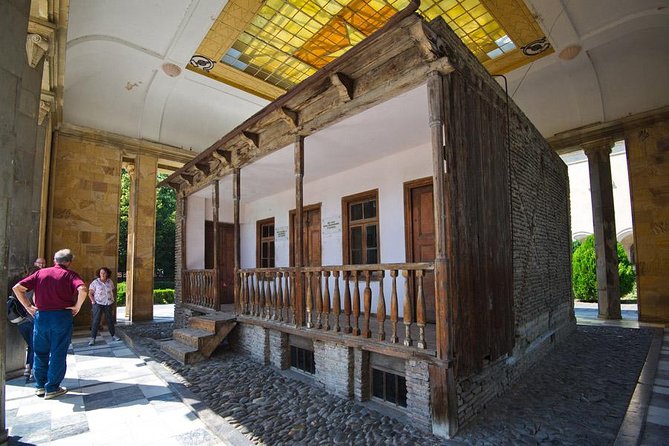
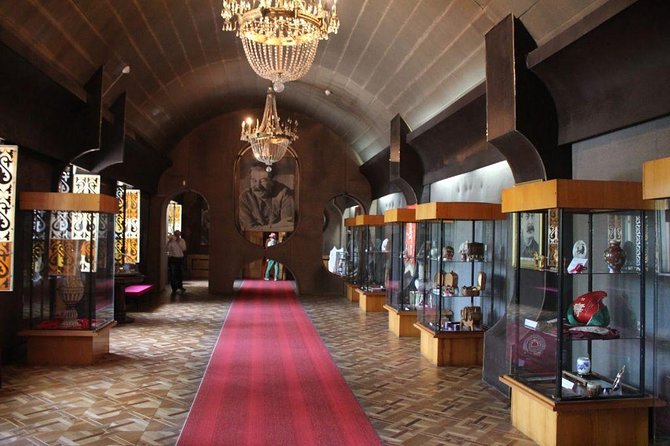
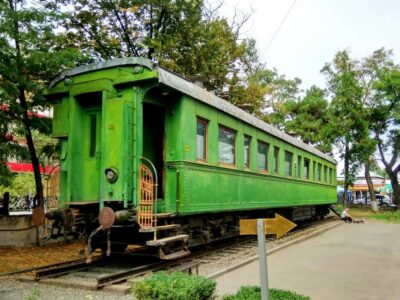
Gori is next, located where the Kura and Liakhi rivers meet in the Kartlia valley. Mountains surround the city on its southern and western sides, but Gori is best known as the birthplace of Joseph Stalin, who ruled the Soviet Union from 1925 to 1953.
The Stalin Museum is scheduled for about 40 minutes, and admission is not included. That time allows for a focused visit, though the subject can easily take longer if you want to read every display and consider the political history in detail.
This is the tour’s most politically charged stop. The museum offers a look at Stalin through the place where he was born and raised, giving you a different angle from the churches and ancient ruins. You should expect a site shaped by memory and presentation, not simply a neutral overview of twentieth-century history.
I see this stop as useful for travelers who want to understand Georgia’s Soviet past. It may be less appealing if your main interest is medieval architecture or outdoor scenery. The private format helps here because you can ask questions and use the guide’s explanation to place Gori within Georgia’s wider story.
Uplistsikhe, a rock-hewn town from around 1000 BC
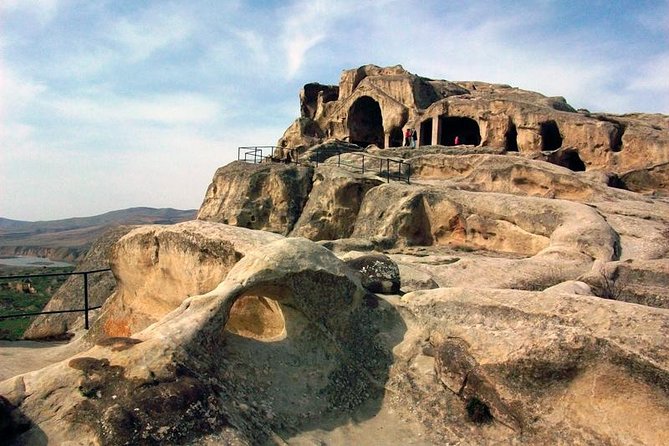
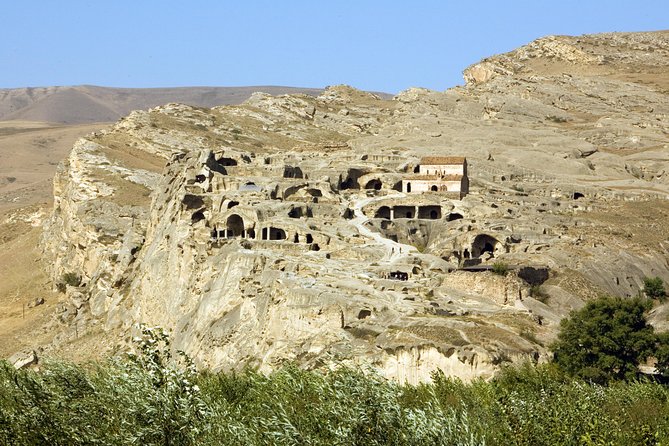
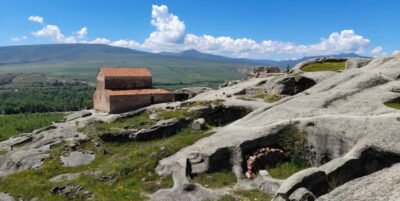
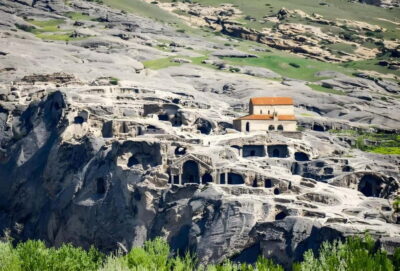
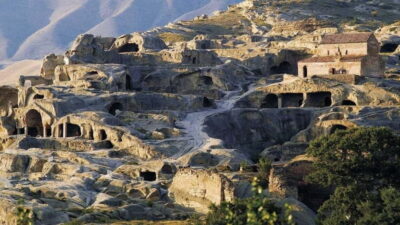
After Gori, the tour reaches Uplistsikhe Cave Town. The name means Lord’s Fortress, and the site is an abandoned settlement carved into rock in eastern Georgia.
Uplistsikhe began in the late Bronze Age, around 1000 BC, and remained inhabited until the thirteenth century. From the sixth century BC through the eleventh century AD, it was an important political and religious center of pre-Christian Kartli, an early predecessor of the Georgian state. At its height, as many as 20,000 people lived here.
The area you visit covers about 40,000 square meters. Its importance comes from the way the town shows how people used rock as an urban setting, not just as a shelter. You can picture rooms, pathways, and public spaces cut into the hillside, along with the religious role the settlement once held.
The planned stop is about 40 minutes, and admission is not included. Wear practical shoes and take care on uneven stone surfaces. The schedule gives you time to see the main section and listen to an explanation, but not to inspect every corner of this large site.
For me, Uplistsikhe is the route’s most distinctive stop. Jvari and Svetitskhoveli are grand religious monuments, while Uplistsikhe feels raw and archaeological. It also makes the day’s timeline easier to understand: Georgia’s story reaches far beyond the medieval churches you see today.
Svetitskhoveli Cathedral in old Mtskheta
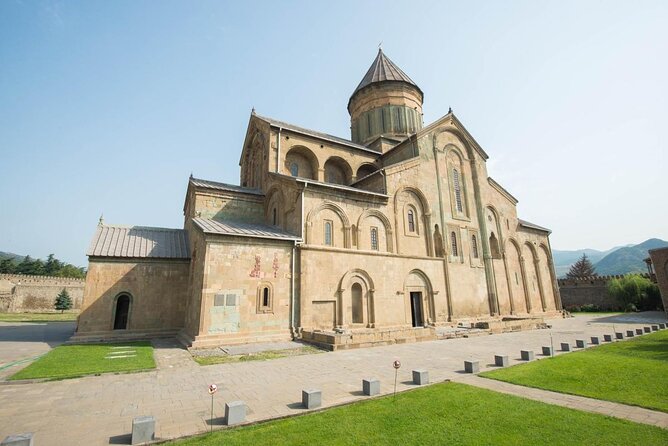
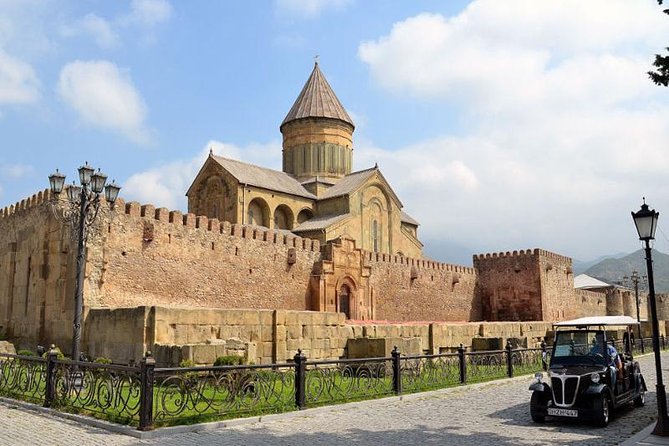
The final major stop is Svetitskhoveli Cathedral in Mtskheta, Georgia’s old capital. The cathedral was built between 1010 and 1029, and you get about 30 minutes here with no admission fee.
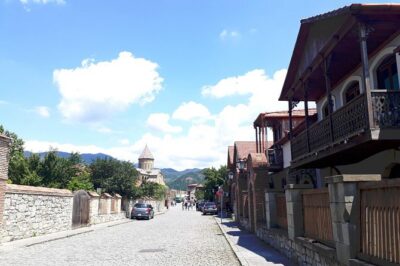
Mtskheta was an important center long before Tbilisi became the country’s main city. Ending here gives the day a clear link back to Jvari, which overlooks the town from above. At Jvari, you see Mtskheta from a distance. At Svetitskhoveli, you enter its religious heart.
The cathedral is associated with four major sacred objects in the Orthodox Christian world: the mantle of the prophet Isaiah, the robe of Jesus Christ, a particle of the Apostle Andrew, and pieces of the cross on which Jesus was crucified. These claims explain the cathedral’s importance to Georgian worship and pilgrimage.
Thirty minutes is a brief visit, so I would focus on the cathedral itself and the guide’s explanation rather than trying to see every detail. Dress and behave respectfully at this religious site. The itinerary does not specify a formal dress code, but modest clothing is a sensible choice for an Orthodox cathedral.
The private format and the value of $179
At $179 per group of up to three people, the price works out to about $60 per person for three people, before extra admission fees and optional activities. For one or two people, the per-person cost is higher, but you are paying for a private experience rather than a seat on a large group bus.
That distinction matters on a long route. You can ask for clarification, discuss how to use limited time at Borjomi, and travel with only your own group. The service also presents its drivers as guides, so you are not simply hiring a transfer between monuments.
The value depends on how much you want to see in one day. If you had to arrange private transport to five separate places, the $179 group price could be attractive. If you prefer slow meals, long walks, or detailed museum visits, the schedule may feel too compressed.
The price does not include every admission. Borjomi Central Park, the Stalin Museum, and Uplistsikhe list admission as not included. The cable car in Borjomi is also an optional cost. Ask the provider what is payable locally before you set out.
Guide service and the human side of the day
The service emphasizes warm Georgian hospitality, and that is where the experience receives its strongest praise. Mamuka is repeatedly connected with friendly, accommodating trips, while Mamu and Ani are praised for guiding the group throughout the day. George and Anna are also named in positive accounts of the service.
The useful detail is not just that the guides are friendly. They are also described as helping with restaurants and shopping, communicating in English and Georgian, and explaining the history of the places visited. That can make a real difference when you are moving quickly through several sites.
You should still treat the guide’s role as part of the value, not a promise of a specialist lecture at every stop. The supplied information describes drivers who also guide, but it does not specify formal archaeological, religious, or museum qualifications.
Timing, comfort, and what to prepare
Pickup is offered in Tbilisi, and the activity begins at 9:00 a.m. It ends back at the meeting point. The total duration is approximately seven to nine hours, so you should reserve most of your day.
The route involves several vehicle sections and short walking visits. You will want comfortable shoes for Uplistsikhe and sensible clothing for the churches. Bring money for admission fees and the Borjomi cable car if you want to use it.
A mobile ticket is available, and confirmation is received at booking. Most people can participate, but the information does not provide detailed accessibility notes. If uneven ground, steps, or walking on rocky surfaces is a concern, ask the provider before booking.
Free cancellation is available if you cancel at least 24 hours before the 9:00 a.m. start time. Cancellations or changes made within 24 hours are not refunded or accepted.
Who should book this Georgia day tour?
I would recommend it to a first-time visitor based in Tbilisi who wants a broad introduction to Georgia beyond the capital. It suits couples, families, and small groups of friends who value a private vehicle, local assistance, and a full day of varied sights.
It is especially good for you if you want to combine:
- Christian monuments and Georgian religious history
- Mineral water and mountain scenery
- Soviet history in Gori
- Ancient archaeology at Uplistsikhe
- A short visit to Georgia’s old capital
I would hesitate if you want a relaxed day with long stops. The five-site plan is ambitious, and the 30 to 45 minute visits leave little room for lingering. I would also think twice if Borjomi’s park or the Stalin Museum is your main reason for booking, since the time at both is limited.
Final verdict: a strong overview with a fast pace
This is a well-chosen route for seeing several sides of Georgia in a single private day. I like the combination of Uplistsikhe’s ancient rock rooms and Borjomi’s natural setting, and I appreciate that Jvari and Svetitskhoveli connect the scenery to Georgia’s Christian past.
The tour’s biggest strength is its range, supported by guides such as Mamuka and Mamu, who are praised for friendly service and practical help. Its weakness is the clock. You will collect many memorable impressions, but you will not have unlimited time at any one place.
Book it if you want efficient sightseeing, private transport, and a guide who can help tie the sites together. Skip it in favor of a slower custom trip if you would rather spend half a day at Uplistsikhe, take a full walk in Borjomi, or study the Stalin Museum at length.
FAQ
How much does the tour cost?
The price is $179 per group of up to three people.
How long does the tour last?
The tour lasts approximately seven to nine hours.
What time does the tour start?
The tour starts at 9:00 a.m.
Where does the tour begin and end?
It begins in Tbilisi, Georgia, and ends back at the meeting point.
Is hotel pickup offered?
Pickup is offered, but the provided information does not specify the exact pickup locations or whether every hotel is included.
Which places are visited?
The tour visits Jvari Church, Borjomi Central Park, the Stalin Museum in Gori, Uplistsikhe Cave Town, and Svetitskhoveli Cathedral in Mtskheta.
Are admission tickets included?
Admission is listed as free for Jvari Church and Svetitskhoveli Cathedral. Admission is not included for Borjomi Central Park, the Stalin Museum, or Uplistsikhe Cave Town. The Borjomi cable car is also not included.
Can I cancel for a full refund?
Yes. You can receive a full refund by canceling at least 24 hours before the experience start time. Cancellations within 24 hours are not refunded.
More Days Out to Borjomi and Bakuriani
- Day tour to Vardzia, Borjomi in Georgia
★ 4.5 · 152 reviews - Vardzia, Rabati, and Borjomi Ancient Georgia Group Tour
★ 4.5 · 74 reviews - From Tbilisi: Borjomi, Rabath and Vardzia Day Trip
★ 4.6 · 66 reviews - LEGENDARY PLACES OF GEORGIA: VARDZIA, BORJOMI, RABAT.( Group Tour)
★ 4.5 · 58 reviews
More Mtskheta and Jvari Half-Days
- Tbilisi: Mtskheta Jvari Bazaar, Chronicles of Georgia & Wine
★ 5.0 · 1,088 reviews - Tbilisi:Mtskheta,Jvari,Bazaar,wine tasting,Chronicles of Georgia
★ 5.0 · 730 reviews - Tbilisi: The Chronicles of Georgia, Jvari & Mtskheta Tour
★ 5.0 · 307 reviews - From Tbilisi: Mtskheta, Jvari, Gori & Uplistsikhe Cave Tour
★ 4.7 · 296 reviews
Just added near Tbilisi
- Wine Tasting feel the Difference of Qvevri or Classical Wine★ 4.4 · 10 reviews
- Walking Tour in Old Tbilisi – Group Tour★ 4.5 · 8 reviews
- From Tbilisi: Kakheti and Kazbegi 2-Day 4X4 Jeep Tour pack★ 5.0 · 6 reviews
- Tbilisi: Vintage Fashion and Secondhand Thrifting Tour★ 5.0 · 11 reviews
- Uforgatable Kakheti Tour with wine tasting – in Georgia★ 4.9 · 5 reviews
- From Tbilisi: Uplistsikhe Caves and Mtskheta Town Day tour★ 5.0 · 2 reviews
- Tbilisi Airport to Gudauri, Bakuriani, Batumi, Tbilisi★ 5.0 · 3 reviews
- Private Adorable City Tour of Tbilisi★ 5.0 · 3 reviews
Gori and Stalin Museum Tours, compared.
Mtskheta, Jvari, Gori and Uplistsikhe Day Tour
Read our review →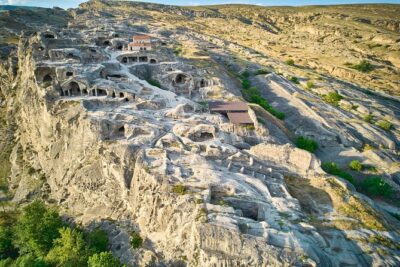
Mtskheta, Jvari, gori, uflistsikhe, history and panorama (group tours)
Read our review →Browse the lists this tour appears in