
Reviewed · CITY TOURS
Tbilisi: City Highlights Walking Tour
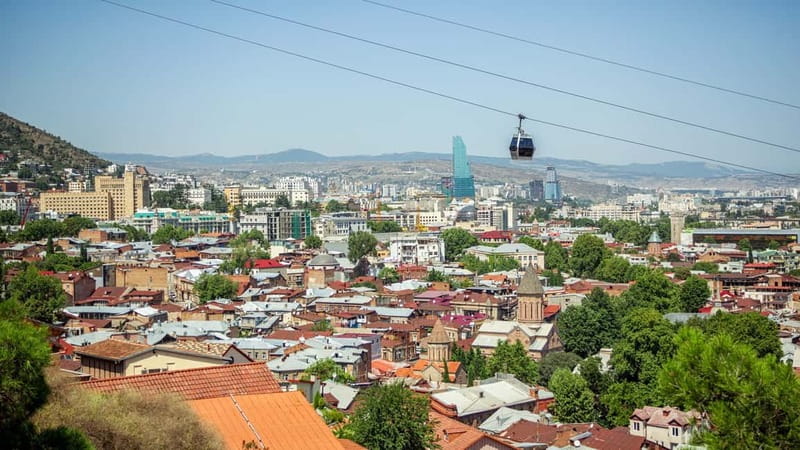
Tbilisi rewards curious walkers. This four-hour tour brings together Old Town architecture and the city’s peaceful mix of Georgian Orthodox, Armenian, Jewish, and Muslim places of worship. I especially like the cable-car ride to Narikala Fortress and the chance to see Tbilisi from several heights, not just from street level.
I also like the compact route. You can move from a mosque to a synagogue, churches, cafés, and old lanes without spending the day in a vehicle. The main consideration is that this is a walking tour in name and in practice: expect about 2.5 kilometers, stairs, hills, and extra payment for the cable car and funicular.
In This Review
- Key points to know before you book
- Why this four-hour route works well in Tbilisi
- Old Town architecture from Georgian to Neoclassical
- A close look at Tbilisi’s religious neighborhoods
- Metekhi Church and Vakhtang Gorgasali
- Cable car to Narikala Fortress
- Walking down through the sulfur-bath district
- Sharden streets, cafés, and the living old city
- Sioni Cathedral, Anchiskhati Basilica, and Gabriadze’s clock tower
- Finishing high on the Tbilisi funicular
- Walking demands, guide language, and what to bring
- Is the $60 price good value?
- Who should book this Tbilisi walk?
- Should you book it?
- FAQ
- How long does the Tbilisi City Highlights Walking Tour last?
- How much does the tour cost?
- Is hotel pickup included?
- Which languages are available?
- Are cable-car and funicular tickets included?
- How far do you walk?
- What should you bring?
- Is the tour suitable for wheelchair users?
Key points to know before you book
- Four hours with hotel pickup and drop-off: The guide collects you at your Tbilisi hotel and returns you there after the tour.
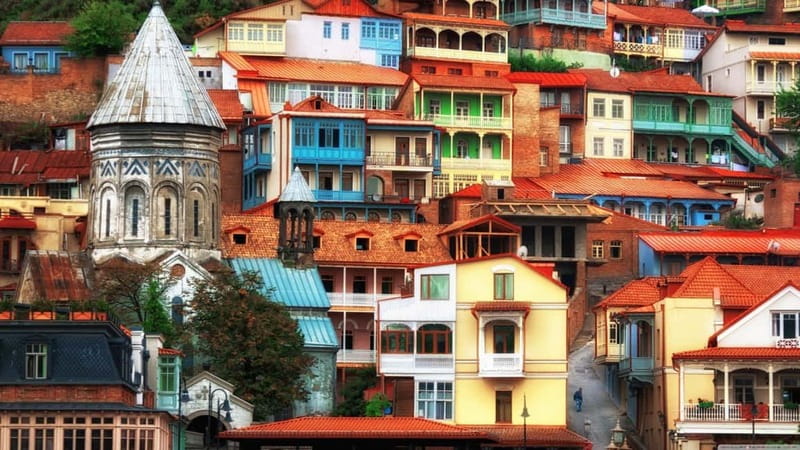
- A strong introduction to Old Town: Georgian, Byzantine, Oriental, and Neoclassical European styles appear within a compact area.
- Several religions in one walk: The route includes a synagogue, Armenian Church, mosque, and Georgian Orthodox churches.
- Two excellent city views: You ride the cable car toward Narikala Fortress, then take the funicular railway for another broad view of Tbilisi.
- Mostly on foot: Comfortable shoes matter. The route is not suitable for wheelchair users.
- Tickets cost extra: Cable-car and funicular fares are not included in the $60 price, so carry some spending money.
Why this four-hour route works well in Tbilisi

Tbilisi can feel confusing at first. The old city sits between hills, the Mtkvari River, fortress walls, churches, bathhouses, cafés, and newer streets. A guide gives you a useful framework before you begin exploring alone.
The route is also well shaped for a first visit. You start among the city’s oldest streets, move through several faith communities, climb for a fortress view, walk downhill through the sulfur-bath district, and finish above the city on the funicular. I like that progression because it alternates close-up details with wide views.
The price is $60 per person. For four hours of guiding, hotel pickup, and hotel drop-off, that can be fair if you want a structured introduction and a guide who can explain local places as you go. It is less attractive if you prefer to move slowly, enter every building, or explore independently.
You should also budget for the cable car and funicular railway. Those fares are not included, and neither is any separate museum guide fee if a museum visit is suggested during your outing. Ask exactly what is included before agreeing to an added stop.
More Walking Tours in Tbilisi
- Tbilisi Walking Tour Including Cable Car and Traditional Bakery
★ 5.0 · 1,310 reviews - Tbilisi: City Highlights Guided Walking Tour
★ 4.9 · 1,114 reviews - Tbilisi:Evening Walking & Talking Tour with Wine & Boat Ride
★ 5.0 · 572 reviews
Old Town architecture from Georgian to Neoclassical
The first part of the walk takes place in Tbilisi’s historic center, where the architecture changes quickly from one street to the next. You will see Georgian forms alongside Byzantine, Oriental, and Neoclassical European influences.
That variety is one of the best reasons to take the tour on foot. From a vehicle, the city can look like a blur of old façades and narrow lanes. Walking lets you stop, look upward, and notice how different periods sit side by side.
I would pay close attention to the way the old district feels as a lived-in neighborhood rather than a preserved film set. The route includes cafés, wine-tasting bars, souvenir shops, and small streets around Sharden. Some areas are polished for visitors, but the tour also gives you a sense of how the historic center remains part of daily city life.
The pace matters here. Four hours sounds generous, but Tbilisi’s hills, viewpoints, and religious buildings can take time. If your guide pauses to explain an architectural detail or a local custom, that is time well spent. You are not simply collecting photographs of façades. You are learning how several cultural influences met in one city.
A close look at Tbilisi’s religious neighborhoods
The religious stops are the most meaningful part of the route for me. Within a fairly small area, you can see a synagogue, an Armenian Church, a mosque, and Georgian Orthodox churches.
This close proximity gives the walk more weight than a standard architecture tour. You are not only looking at separate buildings. You are seeing how different religious traditions occupy the same urban center. The tour presents this coexistence as an important part of Georgian tolerance.
The route includes the Mosque, described as the only mosque in Tbilisi. That makes the stop especially useful for understanding the city’s cultural mix. You also visit Georgian Orthodox sites, including Sioni Cathedral and Anchiskhati Basilica, and the Armenian Church.
Sioni Cathedral offers one of the major religious landmarks in the Old Town portion of the walk. Anchiskhati Basilica gives you another look at Georgian Orthodox tradition, while the Armenian Church adds an important neighboring perspective. I would not rush these stops. Even if you are not religious, the differences in style, use, and atmosphere help explain Tbilisi better than a list of dates can.
Ask your guide about visiting etiquette before entering any religious building. Dress modestly and follow instructions about photography. The supplied details do not promise entry into every site, so treat the route as an opportunity to see and discuss these buildings rather than a guarantee of an interior visit at each one.
Metekhi Church and Vakhtang Gorgasali
Metekhi Church is one of the key landmarks on the tour. It sits near the monument to Vakhtang Gorgasali, the Georgian king associated with the second half of the fifth century.
This stop connects the physical city with one of its founding stories. The monument and church also help you understand why Tbilisi’s setting matters. From this part of the route, you can look across the river and see how the old city developed around steep ground and limited crossings.
I like this stop because it is not only a church visit. It gives the guide a natural place to explain Georgian identity, medieval power, and the city’s long connection to its river and hills. The exact amount of time spent here will depend on the guide and group, but it is one of the places where a good local explanation can make the setting far more memorable.
The route does involve uneven walking and changes in height. If you have trouble with hills or steps, keep that in mind before booking. The tour is specifically not suitable for wheelchair users.
A slower pace, same corner of the Caucasus:
- Tbilisi: Day Trip to Kazbegi, Gudauri, Gergeti, and Ananuri
★ 4.9 · 3,203 reviews - Day Trip to Kakheti Wine Region Including 9 Wine Tastings
★ 5.0 · 2,774 reviews - Highlights of Caucasus Mountains-Jinvali,Ananuri,Gudauri,Kazbegi(Group tour)
★ 5.0 · 2,682 reviews - From Tbilisi: Kakheti Wine Region Tour with 9 Wine Tastings
★ 4.9 · 2,541 reviews
Cable car to Narikala Fortress
The cable-car ride is one of the clearest highlights. Instead of walking all the way up to Narikala Fortress, you gain height quickly and get a broad view over Tbilisi.
I like the change of pace. After walking through narrow streets and looking closely at churches and façades, the cable car gives you room to see the city as a whole. You can appreciate the old district, the river, and the surrounding hills in one sweep.
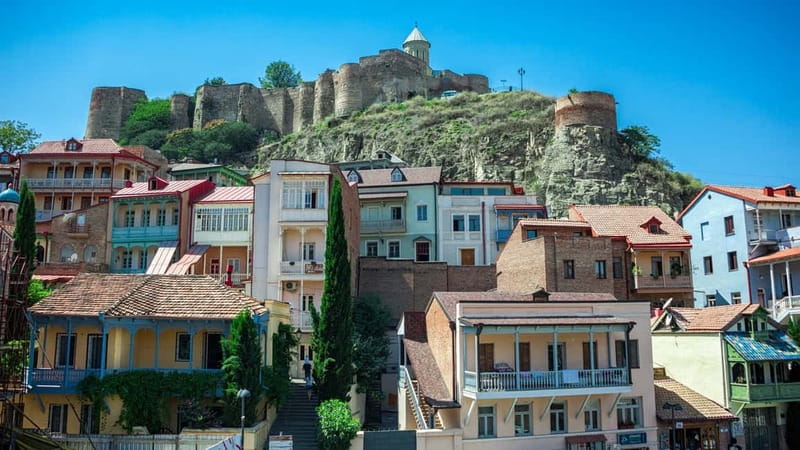
Narikala Fortress adds a strong historical setting to the viewpoint. The tour does not provide a full description of how much of the fortress you will explore, so ask your guide about the planned stop and walking conditions. The main value is the combination of fortress walls and city views, not a long archaeological visit.
The cable-car fare is extra. This is a small but important detail when comparing the tour price with a self-guided day. Carry money for the ride, and do not assume that every form of transport connected with the tour is covered by the $60 fee.
Sunglasses are listed among the useful items to bring. That makes sense at exposed viewpoints, especially when the city opens up below you and there is little shade.
Walking down through the sulfur-bath district
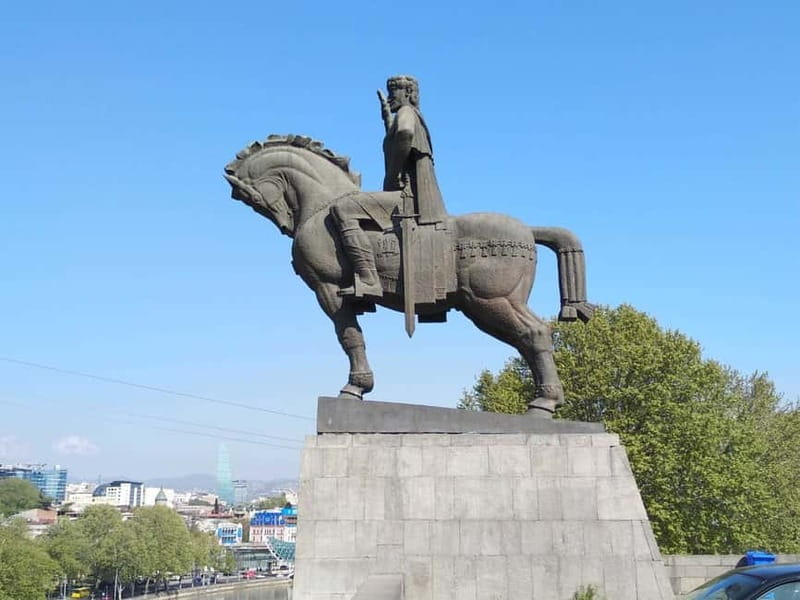
After Narikala, the route walks down toward Tbilisi’s sulfur bathhouses. The downhill direction is helpful, but the path can still involve uneven surfaces and steps.
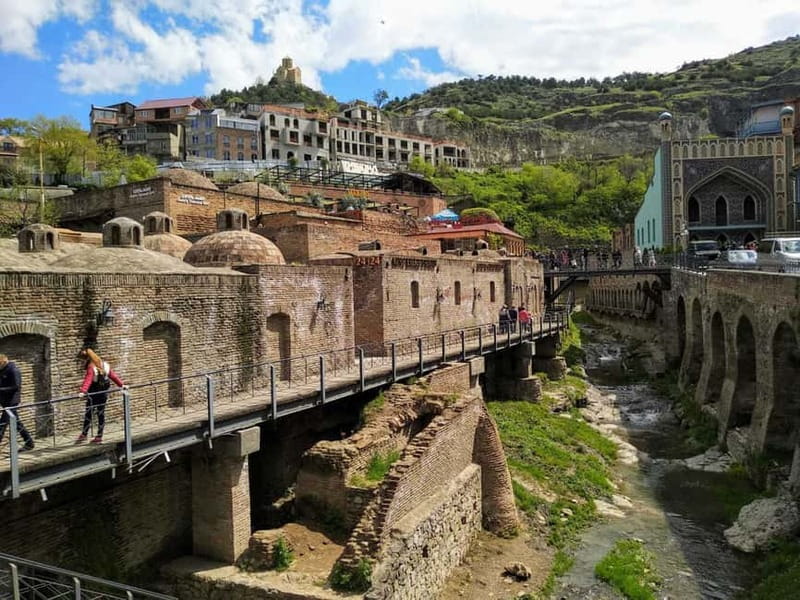
The bathhouse district is one of the city’s most recognizable areas. It gives you a different side of Tbilisi from the fortress and churches. Here, the focus shifts to the city’s bathing tradition, street atmosphere, and the connection between the old center and its natural hot springs.
You also pass the city’s only mosque on this part of the walk. That makes the route feel connected rather than divided into isolated sightseeing stops. The mosque, bathhouses, fortress, and nearby Old Town lanes all belong to the same compact urban story.
Do not expect a bathing session to be part of the tour. The information provided describes a walk through the district, not entry into a bathhouse or a treatment. If you want to use a bath later, ask your guide for practical advice, but that would be separate from this four-hour experience.
Sharden streets, cafés, and the living old city
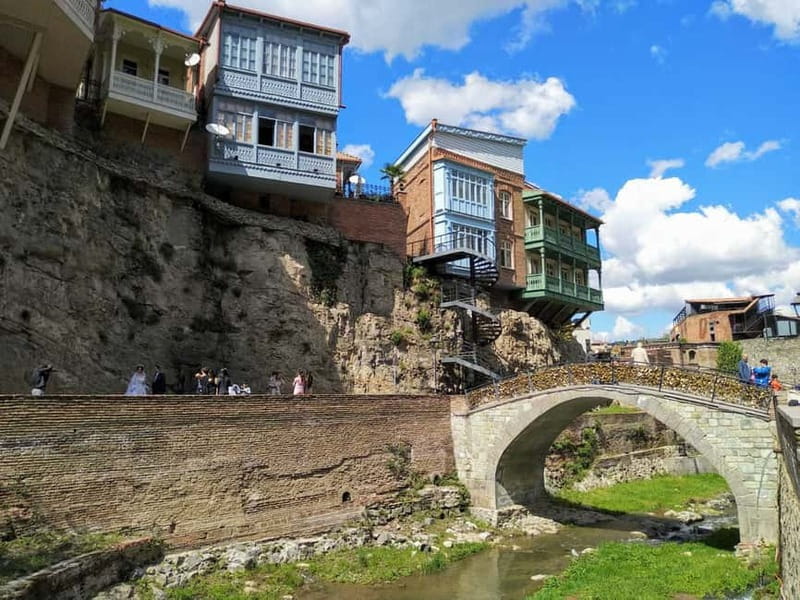
The walk through the Sharden area is the most relaxed part of the itinerary. Its narrow streets contain cozy cafés, wine-tasting bars, souvenir shops, and places where you can pause to watch the city move around you.
This is a useful contrast after the more formal churches and viewpoints. You get a sense of Tbilisi as a social city, not only as a collection of monuments. I like that the route leaves room for the living past, where old streets continue to serve modern businesses.
The area can also be the most commercial section of the tour. Souvenir shops and wine bars are convenient, but they are not automatically the best places to buy something. Use the guide’s local knowledge, compare prices, and save a purchase for later if you want time to think.
The tour may include wine tasting bars as part of the area, but the details do not promise a tasting session or cover tasting costs. Ask before ordering anything. That simple question avoids confusion and helps you keep the day within budget.
Sioni Cathedral, Anchiskhati Basilica, and Gabriadze’s clock tower
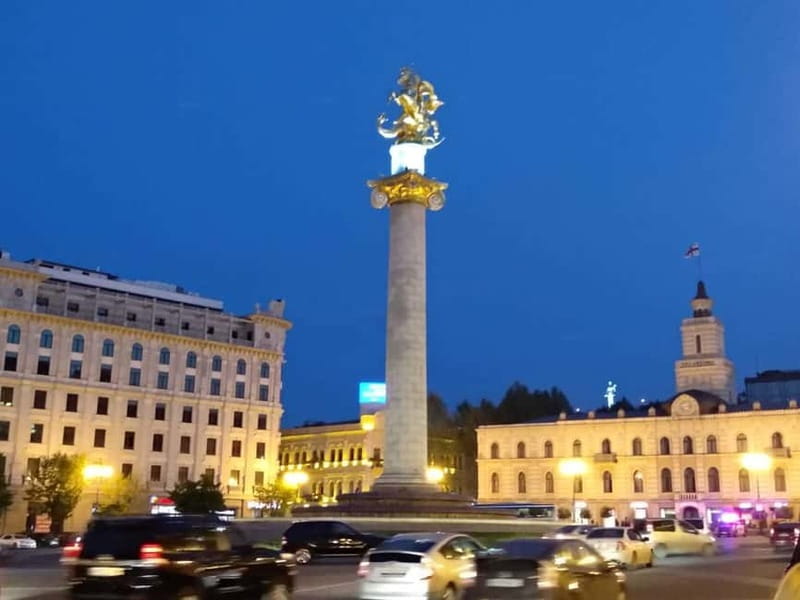
The itinerary returns to several important Old Town landmarks after the fortress and bathhouse district. Sioni Cathedral and Anchiskhati Basilica offer two more opportunities to see Georgian Orthodox architecture and hear how these places fit into the city.
The clock tower of the Rezo Gabriadze Theatre provides a lighter note. Its unusual design is closely linked with the famous theatre, and it adds a playful visual stop to a route otherwise filled with fortresses and churches.
I appreciate this mix. A good city tour needs more than solemn monuments, and the clock tower helps keep the walk varied. It also shows that Tbilisi’s character is not limited to one historic period or one style of building.
Your guide’s storytelling will shape these stops. One past guest singled out the local perspective of hearing what it was like to grow up in Tbilisi, and that is exactly the sort of detail that can make a city walk worthwhile. Another guide, Dito, was praised for making the tour lively and playful. If you are assigned Dito, expect an energetic style based on that account. Guide quality can vary, but personal stories are a real strength when they stay connected to the places around you.
Finishing high on the Tbilisi funicular
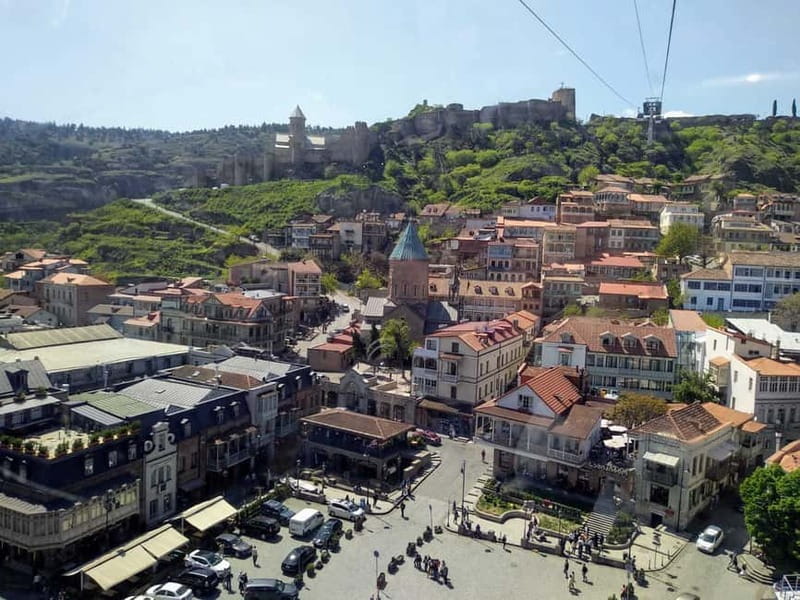
The final major stop is the funicular railway. Like the cable car, it trades a hard climb for a quick ride to an elevated point. The reward is another broad view over Tbilisi, giving you a second chance to understand the city’s shape from above.
I like ending here. The tour begins at street level, moves through religious and historic sites, rises to Narikala, returns to the old streets, and finishes with a final panorama. It feels like a useful visual recap of the city.
The funicular ticket is not included, so plan for that additional cost along with the cable car. The route description calls the view unforgettable, but your experience will depend on weather, visibility, and how much time the group has at the top. Still, it is a fitting close to a first look at Tbilisi.
Walking demands, guide language, and what to bring
Most of the four hours are spent walking. The stated distance is around 2.5 kilometers, but distance alone does not tell the whole story. Hills, stairs, uneven Old Town surfaces, and stops at elevated points make the route more demanding than a flat 2.5-kilometer stroll.
Wear comfortable shoes with a secure sole. Bring sunglasses and your passport or ID card, as those are specifically listed among the recommended items. Large bags and luggage are not allowed, and pets are not permitted.
The tour is offered in English or Russian. English ability may vary by guide. One past booking found the guide enjoyable but felt the English was somewhat limited, while other comments praised clear stories and an engaging style. If historical explanation in fluent English is important to you, confirm the language arrangement when you book.
Hotel pickup and drop-off are included in Tbilisi. That saves you the trouble of finding the starting point, especially useful if you are new to the city. The tour lasts four hours, but starting times depend on availability.
Cancellation is flexible up to 24 hours before the tour for a full refund, and you can reserve now and pay later. Those terms help if your Georgia plans are still changing, but the main decision remains physical: you need to be comfortable walking and using cable transport and a funicular.
Is the $60 price good value?
I see the value in the price if you want local explanation, hotel transport, and a well-organized route through the main historic areas. A guide can connect the synagogue, Armenian Church, mosque, Orthodox sites, fortress, bathhouses, and theatre district in a way that is hard to reproduce on your first morning alone.
The cost is less compelling for independent walkers who already know Tbilisi or who want to spend an hour inside each church. A four-hour group route has to keep moving, and the listed sites are not presented as long interior visits.
Remember the extra transport tickets. Also ask about any optional museum component. A separate museum guide fee of 45 Georgian lari was once requested during a tour, and that charge was not expected by the person involved. The practical lesson is simple: before entering an added museum stop, confirm the fee and decide if it fits your plan.
Who should book this Tbilisi walk?
I would recommend it to first-time visitors who want a solid orientation in one half-day. It suits you especially well if you enjoy architecture, religious sites, city viewpoints, and local stories more than a slow café morning.
It is also a good choice if you want hotel pickup and do not want to manage the first day’s route yourself. The English or Russian guide can help place Tbilisi’s many influences in context, and the cable car and funicular add variety.
I would skip it if you use a wheelchair, dislike hills and stairs, want a private pace, or are trying to avoid all extra transport costs. You might also prefer a self-guided walk if you want extended time in museums or bathhouses, since those are not clearly part of the standard route.
The overall rating attached to this experience is 4.8 out of 5 from nine ratings. The strongest praise centers on the guides’ stories, lively delivery, and the enjoyable route. The main cautions are limited English in at least one case, the walking demands, and possible surprise costs for an optional museum guide.
Should you book it?
Book this tour if you want Tbilisi explained as a connected city, not just a checklist of monuments. The religious mix, Narikala cable-car ride, sulfur-bath district, Sharden lanes, and funicular view give you a well-rounded first look in four hours.
Before paying, confirm the guide language, ask if any museum stop is planned, and budget for both transport tickets. If those details suit you and you can handle the walking, this is a practical and engaging introduction to Tbilisi.
FAQ
How long does the Tbilisi City Highlights Walking Tour last?
The tour lasts four hours.
How much does the tour cost?
The listed price is $60 per person.
Is hotel pickup included?
Yes. Pickup and drop-off from your hotel in Tbilisi are included.
Which languages are available?
The live guide is available in English or Russian.
Are cable-car and funicular tickets included?
No. You must pay separately for the cable car and the funicular railway.
How far do you walk?
You should be prepared to walk around 2.5 kilometers, with much of the tour on foot.
What should you bring?
Bring a passport or ID card, comfortable shoes, and sunglasses.
Is the tour suitable for wheelchair users?
No. The tour is not suitable for wheelchair users.
Just added near Tbilisi
- Wine Tasting feel the Difference of Qvevri or Classical Wine★ 4.4 · 10 reviews
- Walking Tour in Old Tbilisi – Group Tour★ 4.5 · 8 reviews
- From Tbilisi: Kakheti and Kazbegi 2-Day 4X4 Jeep Tour pack★ 5.0 · 6 reviews
- Tbilisi: Vintage Fashion and Secondhand Thrifting Tour★ 5.0 · 11 reviews
- Uforgatable Kakheti Tour with wine tasting – in Georgia★ 4.9 · 5 reviews
- From Tbilisi: Uplistsikhe Caves and Mtskheta Town Day tour★ 5.0 · 2 reviews
- Tbilisi Airport to Gudauri, Bakuriani, Batumi, Tbilisi★ 5.0 · 3 reviews
- Private Adorable City Tour of Tbilisi★ 5.0 · 3 reviews
City Tours, compared.
Kakheti;City of Love Sighnaghi, Bodbe. KTW. Wine House Group tour
Read our review →
Old and New City Guided Tour with 2 Cable Car Rides
Read our review →
Old & New City Guided Tour with 15 Tastings & Wine
Read our review →
Mtskheta – Jvari. Full City Tour on Hop On Hop Off Bus
Read our review →
Day tour to Chronicles of Georgia, Gori city, Uplistsikhe cave
Read our review →Browse the lists this tour appears in